Comparison
CrestCast vs Plum
Plum is an automated saver with a spending tracker attached: it reads your transactions, works out what you can spare and moves it into savings, and shows you what you spent. CrestCast is a budgeting app that works forwards: it tells you what you can spend this month and still get where you are going. That is why CrestCast does not connect to your bank: it is not analysing the past, you type the plan.
| CrestCast | Plum | |
|---|---|---|
| Spending tracker or budgeting app? | Budgeting app. It plans what you can spend now against where you are going, ten years out | Automated saver with a spending tracker attached. It has no feature it calls a budget |
| What it tells you | What you can spend this month and still get where you are going | What you spent, by category, and what it has moved into savings for you |
| Which way it looks | Forwards, ten years, day by day | Backwards, over your transactions, to work out what you can spare. Plum Plan puts a number and a timeline on a goal you set |
| Bank connection | None. It is not analysing the past, so it needs no feed: you type the plan, or import a CSV | Yes, read-only, through Open Banking. Everything it sets aside is worked out from the feed |
| Saving | Set a minimum to hold in the current account and an order for where anything above it goes | Automated rules: an amount Plum calculates you can spare, round-ups to the nearest pound, a weekly or payday deposit, and challenges on the paid tiers |
| Spending | Not categorised. You enter the bills and living costs in the plan | Spend Tracker sorts transactions into 18 fixed categories and compares this month with previous ones. Every category on Boost and Max, the top two below that |
| Net worth | Projected forward year by year, included | Not described on withplum.com or in its help centre |
| Scenarios | Save versions of the plan and compare two side by side | Plum Plan suggests a plan for one goal, as a number and a timeline. Its site calls the projections illustrative and not guaranteed |
| Household | Joint, personal and household views on one subscription | Per user. Its site describes Plum Plan for a Plum user, and nothing on it describes a joint or household plan |
| Price | £79.99/yr for the household, which is £6.67 a month. 30-day free trial with no card | Basic is free. Plus £3.99/mo, Boost £7.99/mo, Max £14.99/mo, monthly only, first month free. Users who joined before 07/07/2025 stay on Pro £2.99, Ultra £4.99, Premium £9.99 |
Plum's prices and tiers correct as at 16/09/2026. Taken from Plum's own subscriptions page, with the rest of the row checked against its help centre and feature pages. Two sets of Plum plans run at once, so the cell says which one a new sign-up sees. Plum changes its plans from time to time, so check its site before you pay for a tier.
Plum is a trademark of its owner; this comparison is independent and is not affiliated with or endorsed by Plum.
A budget is a plan for money you have not spent yet
Plum's engine works backwards by design. In its own words it connects to your bank account, analyses your transactions, identifies your regular income, rent, bills and daily spending, and from those works out each day what can be put aside without affecting your daily life. The output is a transfer, made for you, every four or five working days. The Spend Tracker beside it sorts what you spent into eighteen categories and compares this month with previous months. Neither of them is a budget, and Plum does not call either one a budget.
A household's questions mostly cannot be answered from what it spent. Whether the mortgage is still affordable when the fix ends. What one of you going part time does to the next five years. When the car finance is gone and what that frees up. Those are about money that has not moved yet, and a feed of money that has cannot see them. CrestCast starts from what is coming, builds the next ten years from it day by day, and works back to what you can spend this month without missing any of it.
Plum does look forward once, in Plum Plan. You tell it when you want to stop working and how much you want to put in, and it puts a number and a timeline on that. It is a goal projection, per user, with the page's own warning that the projections are illustrative. It does not say what your current account holds next March. The fuller argument, with every UK app placed on its rung, is on budgeting app vs spending tracker.
What a budget that works forwards looks like
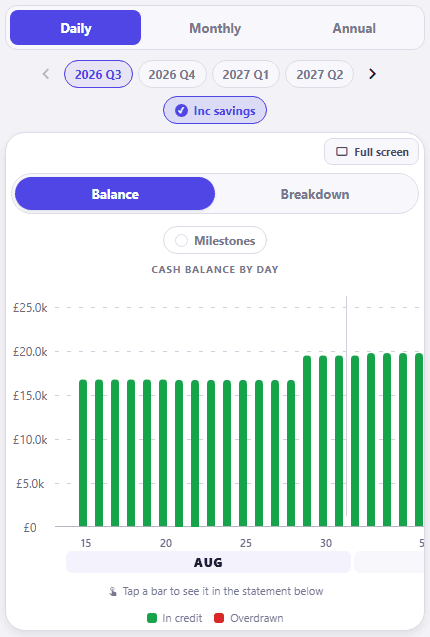
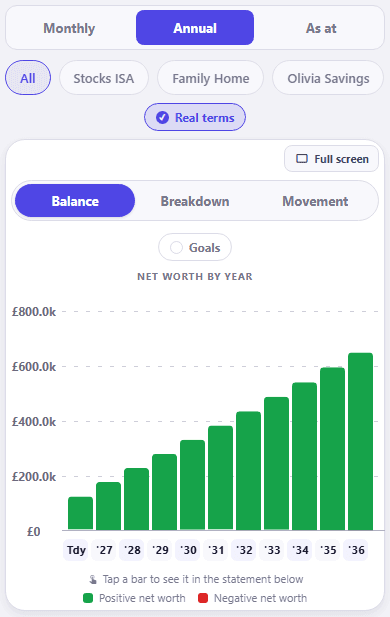
Figures shown are the sample profile, not a real household.
Where CrestCast is different
No bank connection, and the trade is deliberate. Plum reads your accounts because its whole job is to find spare money in them; CrestCast asks you for the figures, and in return nothing reads your accounts and the model holds exactly what you chose. Here is why we built it that way.
No automated saving, no round-ups and no investing. Plum does all three well, and each is about acting on money you already hold. CrestCast moves nothing: it works out what the current account needs to hold, puts an order on where anything above that goes, and shows what that does to your cash and your net worth ten years out. Plum Plan projects an outcome for the age you want to stop working; CrestCast does not do retirement planning, and stops at ten years. If a decision is coming that the past cannot answer, you need the budget that works forwards.
Which should you choose?
Choose CrestCast if the question is what you can afford: a bigger house in two years, one income for a while, a debt you want gone by a date, two incomes that need to be looked at as one household. It shows what the decision does before you make it, across your cash, your income and your net worth at once. Choose Plum if the question is how to save without thinking about it: the spare money found and moved for you, purchases rounded up into a pot, and a tracker to see where the rest went.
A couple looking at one set of finances together will find the household half on CrestCast for couples.
Common questions
›Is Plum a budgeting app?
Plum does not call itself one, and it has no feature it calls a budget. Its own description is that it connects to your bank account, analyses your transactions, works out each day what can be put aside without affecting your daily life, and moves that amount into your Plum account. That is an automated saver. A Spend Tracker sits beside it, sorting what you spent into categories and comparing this month with previous months. The forward-looking feature is Plum Plan, which takes a goal, in the page's own example the age you want to stop working, and puts a number and a timeline on it. On the test this site uses, what you spent versus what you can spend and still get where you are going, Plum is a spending tracker attached to a saver.
›What is the difference between a budgeting app and a spending tracker?
A spending tracker reads your bank feed and tells you where the money went: categories, this month against last, a report you look at after the fact. A budgeting app tells you what you can spend now without missing something later, which means it has to know what is coming: the fix ending in March, the car finance finishing in 2028, one salary dropping for a year. A budget is a plan for money you have not spent yet, so it cannot be built from money you already have. CrestCast builds that plan ten years out, day by day, and works back to this month. Plum reads what you spent and decides what to set aside from it.
›Does CrestCast connect to my bank?
No, and the reason follows from the split rather than excusing it. Plum needs a bank connection because everything it does starts from your transactions: it reads them to find what you can spare. CrestCast is not reading what you spent. The figures a forward budget runs on are not in a statement: the pay rise you have been promised, the nursery fees that start in September, the house you mean to buy in two years. So you type the plan, which takes an evening the first time, or hand it a CSV your bank exported and let it pick out the payments that repeat. No credential is shared, and the model holds exactly what you decided.
›What does Plum do that CrestCast does not?
Everything on the saving and investing side. Plum connects to your accounts through Open Banking, calculates what you can spare and moves it for you, rounds purchases up to the nearest pound and saves the difference, runs weekly, payday and challenge deposits, categorises your spending into a tracker with month-on-month comparison, and lets you invest from the same app. Plum Plan projects an outcome against the age you want to stop working. CrestCast does none of that: it moves no money, holds no money, and does not do retirement planning. If the job is saving without having to think about it, Plum is the better choice.
›How much does Plum cost?
Checked on 16/09/2026 against Plum's own subscriptions page: a UK user signing up now sees Basic free, then Plus at £3.99 a month, Boost at £7.99 and Max at £14.99, monthly only, with the first month of a paid tier free. Anyone who joined before 07/07/2025 stays on the four classic plans, Basic free, Pro £2.99, Ultra £4.99 and Premium £9.99, which Plum's help centre says it still offers. The Spend Tracker shows every category on Boost and Max and the top two on Basic and Plus, and four of the saving rules need a paid tier. CrestCast is £79.99 a year for the whole household, which works out at £6.67 a month: 30 days free, then 14 days after the first payment to change your mind, 44 days in all before any money is spent for good.
›Can I use Plum and CrestCast together?
Yes, and they fit well: Plum to move the spare money into savings without deciding each time, CrestCast to decide how much spare there should be and where it goes once the current account has what it needs. Nothing needs integrating and no data passes between them. The forward budget improves the saver too, because a minimum to hold in the current account is exactly the figure Plum's algorithm is trying to guess.
Other comparisons
- Budgeting app vs spending tracker →
The five rungs from a transaction list to a plan, and which UK app stands on which.
- CrestCast vs Emma →
A spending tracker with a monthly budget on top, next to a budget that works forwards.
- CrestCast vs Snoop →
A bill-cutting spending tracker, next to a budget that works forwards.
- CrestCast vs YNAB →
A budget for this month only, next to one that runs ten years.
- UK money apps compared →
Snoop, Emma, Plum, Monzo, YNAB and PocketSmith: tracker or budget, and how far ahead each one looks.
- CrestCast for couples →
Joint, personal and household views of one plan, on one subscription.
This is not advice
This comparison is independent and is not affiliated with, endorsed by, or sponsored by Plum or Plum Fintech Ltd. Details about Plum are drawn from withplum.com and its help centre, checked on 16/09/2026, and may be out of date by the time you read this. Check Plum's own site for current features and pricing. Nothing here is financial advice.
Plum decides what to set aside. CrestCast tells you what you can spend and still get where you are going.
Both incomes, the bills, the mortgage and the children in one forward budget, ten years out, so the decisions that cannot be undone stop being guesses.
Try CrestCast free →30-day free trial, no card needed to start · 14 days to change your mind after you pay