Free interactive tool
UK personal finance flowchart
The standard UK answer to “I have some spare money, what should I do with it?” is an eight-step order of operations, and it normally arrives as a picture you can only read. The map below is one you can use. Type your own numbers in and it marks the step you are standing on, then says what your next spare £100 should actually do.
It is current for the 2026/27 tax year, and it does something a picture cannot: it names the parts of the answer that are already scheduled to change, with the dates. The cash ISA limit is cut in April 2027 and the Lifetime ISA is replaced in April 2028, which quietly dates most of the copies of this chart in circulation.
Credit where it is due
The order of operations below is community knowledge, maintained by the volunteers behind the UKPersonalFinance wiki flowchart, which is the canonical version and worth reading in full. This page is an independent implementation of that widely published order. The step numbering and the ordering here follow their chart exactly, checked against version 3.0.10 (dated 22/12/2025) on 25/08/2026. If you find this useful, the wiki is the thing to go and read next.
Their chart is published under a Creative Commons Attribution-NonCommercial-ShareAlike 4.0 licence. We reproduce no part of it here: not the image, not the text, not the layout. CrestCast is not affiliated with, endorsed by, or connected to the UKPersonalFinance wiki or the volunteers who maintain it.
Allowances shown are for the 2026/27 tax year. Figures correct as at .
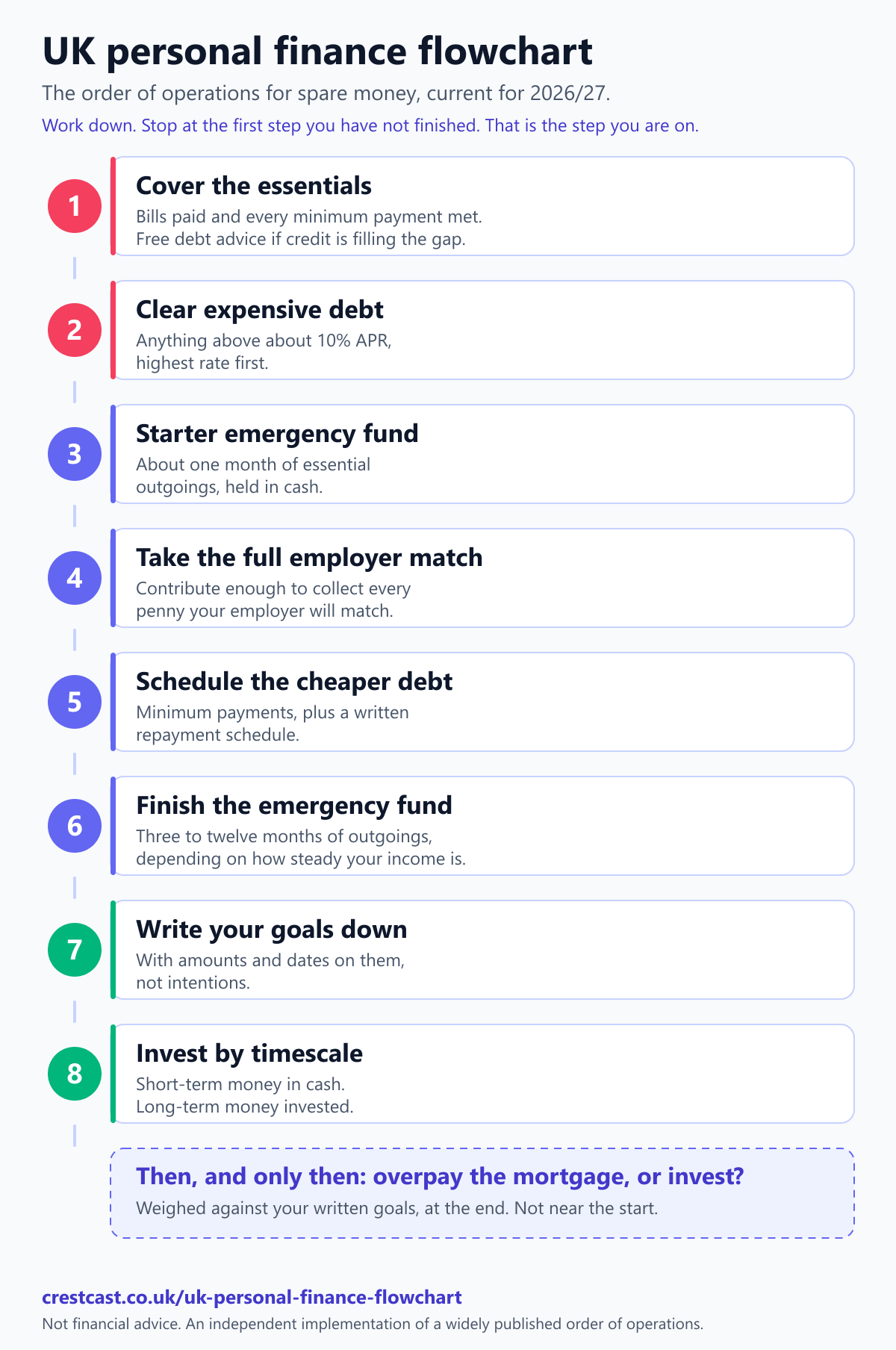
The eight steps, in order
Four phases, eight steps, and one fork at the end. You only move down once the step above is genuinely handled, because each one protects everything below it. Open any step for what it involves. Answer the questions underneath and the map marks the step you are standing on.
Steady the ground
Nothing above this line is optional. Every step after it assumes this one is done.
- 1
Budget, cover the essentials, clear expensive debtHousing, council tax, food, energy, insurance, minimum payments on everything, and any debt above 10% APR attacked highest rate first.What this involves
- Write down every essential cost: rent or mortgage, council tax, energy, water, food, and whatever it costs to get to work.
- Check what you are entitled to. Benefits and council tax support go unclaimed every year by people who assumed they would not qualify.
- Insure the things that would sink you: car cover (legally required), home cover, life cover if anyone depends on your income, and income protection.
- Pay at least the minimum on every debt, always. Missing a payment costs more than the interest does.
- If you are relying on credit or an overdraft to cover essentials, stop here and get free debt advice. That is not a failure, it is the correct move.
- Then clear anything above 10% APR, highest rate first, before building savings. Above that rate, clearing the debt beats any return you can count on elsewhere, and it is guaranteed. Refinance where you can: a balance transfer or a lower rate loan cuts the cost without needing more money.
- Cheaper debt waits. It gets its minimum payment now and a proper look at step 4.
Move on once: Bills paid without borrowing, and nothing left above 10% APR.
- 2
Build a starter emergency fundOne to three months of outgoings, in cash you can reach the same day.What this involves
- The job of this money is not growth. It is to stop the next boiler, tyre or vet bill turning into a credit card balance.
- Instant access, separate from the current account so it does not get spent by accident.
- One month is enough to move on from. Three is more comfortable if your income is lumpy.
Move on once: One month of outgoings, in cash you can reach the same day.
Take the money that is free
The only step where a pound arrives from somewhere other than your own income.
- 3
Take the full employer pension matchContribute enough to collect every pound your employer will match.What this involves
- A match is money added on top of your own contribution. Nothing else on this list adds that much for so little risk.
- Check the scheme rules for the maximum percentage your employer will match, then contribute at least that much.
- Tax relief comes on top, so the cost to your take-home pay is less than the amount going in.
Move on once: Every matched pound your employer offers is being collected.
Clear the decks
The cheaper debt gets a plan, and the buffer gets finished. In that order, for a reason.
- 4
Put the remaining debts on a scheduleAnything left that is not the mortgage or a student loan gets a written repayment plan, weighed against what savings pay.What this involves
- By this point nothing you owe should be above 10% APR, because step 1 cleared it. What is left is the cheaper kind: the car loan, the 0% card, the sofa on finance.
- Write down when each one clears at its current payment, then compare each rate with what an easy-access savings account pays. A debt charging less than savings earn is not urgent. One charging more is worth overpaying once the emergency fund is under way.
- Keep paying at least the minimum on all of them, always.
- The mortgage and any student loan sit outside this step on purpose. Whether overpaying those beats saving or investing is a genuine question with its own arithmetic, and the order comes back to it right at the end, once your short-term goals are on track.
Move on once: Every remaining debt has a written schedule and its minimum payment.
- 5
Finish the emergency fundThree to twelve months of outgoings, depending on how stable your income is.What this involves
- Three months suits a secure salary with another earner in the household.
- Six to twelve suits self-employment, commission, a single income, or a job that would be slow to replace.
- Still cash, still instant access. This is the money that buys you the time to make good decisions instead of desperate ones.
Move on once: Three to twelve months of outgoings banked, whichever suits your income.
Point the rest somewhere
Now it matters what you actually want, and when you want it.
- 6
Define your goals with amounts and datesA goal without a number and a date cannot be planned for, only hoped for.What this involves
- The defensive work is done, and this is also the point where the order tells you to look at the budget again and loosen the discretionary spending if you want to. Then give what is left a job.
- Name each one: deposit, wedding, car, career break, retirement.
- Give every goal an amount and a target date. The date is what picks the account, and the amount is what tells you the monthly figure.
- The date sorts the goals into the next two steps. Under five years is one kind of money. Over five years is a completely different kind.
Move on once: Every goal has an amount and a date. The date is what decides the rest.
The order splits here
When do you need the money?
Steps 7 and 8 are not one after the other. They are two answers to that question, and 5 years is the line between them. Most people have goals on both sides of it.
Needed within five years
7Short-term goals, under five yearsCash Lifetime ISA for a first home, savings accounts, Premium Bonds.What this involves
- Under five years the job of the money is to still be there on the day you need it, not to grow.
- A cash Lifetime ISA adds a 25% government bonus on up to £4,000 a year, worth up to £1,000, for a first home up to £450,000. You have to be 18 to 39 to open one, and taking the money out for anything else before 60 carries a withdrawal charge. (2026/27 rules.)
- This one has a shelf life. The Lifetime ISA is proposed to be replaced by a First Time Buyer ISA from around April 2028, and the cash ISA limit is being cut for under-65s from 6 April 2027. Existing Lifetime ISA holders are expected to keep contributing and keep the bonus. See what changes next, further down this page.
- Otherwise a plain savings account, a fixed term account if the date is certain, or Premium Bonds if you would rather have the option of a win than a predictable rate.
- Investing money you need in three years is how people end up selling at the worst possible moment.
Five years away or more
8Long-term goals, over five yearsStocks and Shares ISA, Lifetime ISA, workplace pension, SIPP, then a General Investment Account.What this involves
- Over five years the risk flips. Cash is the thing that quietly loses, and the Stocks and Shares ISA is the usual home for money you will not touch. The overall ISA allowance is £20,000 a year in 2026/27, and from 6 April 2027 more of it has to sit outside cash if you are under 65.
- The order splits this step by when you will want the money relative to your pension access age, which it puts at roughly 58. Money needed before then goes to ISAs or a General Investment Account, because a pension will not give it back in time. Money for after goes to the pension first, because nothing else matches the tax treatment. The minimum pension age rises from 55 to 57 on 6 April 2028, and the chart plans around 58 to leave room for further rises.
- If you pay 40% or more, a SIPP or extra workplace contributions get relief at your marginal rate, inside a £60,000 annual allowance in 2026/27.
- A Stocks and Shares Lifetime ISA carries the same 25% bonus and the same rules as the cash version, and the same April 2028 replacement, which suits a first home that is genuinely years away.
- Inside whichever account wins, what the order actually points at is long-term investing in low-cost index funds. Picking individual shares is not on the chart.
- A General Investment Account comes last, once the tax-free allowances are genuinely used up. Dividend tax rose by 2 percentage points in April 2026, so the gap between inside and outside an ISA got wider, not narrower.
- One more thing before the money is invested: if the mortgage or a student loan is still there, this is where the order has you weigh an overpayment against your goals. Not before.
Which step are you on?
Seven quick questions, all of them skippable. Answer what you know and you still get a useful answer, with the gaps named rather than guessed at.
Question 1 of 7
Relates to step 1
What do your essentials cost each month?
Rent or mortgage, council tax, energy, water, food, insurance, and getting to work. Not holidays or takeaways.
Nothing you type here is sent anywhere or stored. It stays in your browser, and refreshing the page clears it. Debts above 10% APR are the ones the order treats as urgent.
What changes next, and when
The order of the eight steps is stable. The products at the bottom of it are not. These are the dated changes already announced.
- 6 April 2027Announced
The cash ISA limit is cut for under-65s
- The amount you can put in a cash ISA falls from £20,000 to £12,000 a year if you are under 65.
- The overall £20,000 ISA allowance is unchanged. The remaining £8,000 can still be used, but only in a Stocks and Shares ISA, an Innovative Finance ISA or a Lifetime ISA.
- From the tax year in which you turn 65, the full £20,000 cash limit is kept.
- Anti-circumvention rules land at the same time: a flat 22% charge on interest paid on cash held inside a non-cash ISA, a bar on non-cash ISA portfolios being made up entirely of cash-like assets (money market funds are the defined cash-like asset), and no transfers from a non-cash ISA into a cash ISA. The transfer bar does not apply to those aged 65 and over.
GOV.UK: ISA reform 2027 anti-circumvention rules factsheet →
- Around April 2028Detail not final
The Lifetime ISA is replaced by a First Time Buyer ISA
- The Lifetime ISA is being scrapped and replaced with a product aimed only at buying a first home. The retirement purpose goes.
- HM Treasury consulted on the design from 22 June to 18 August 2026, and the fine print is not final until the government responds. The proposal is a product open to first-time buyers aged 18 and over with no upper age limit, available as cash or Stocks and Shares, with no 25% withdrawal penalty, and with the bonus paid as a lump sum at purchase rather than year by year.
- If you already hold a Lifetime ISA you can keep paying into it indefinitely and keep the 25% bonus. Existing Lifetime ISAs cannot be transferred into the new product.
- This is why step 7 below flags a shelf life on the cash Lifetime ISA rather than presenting it as a permanent fixture.
- Now, until April 2031Announced
Income tax thresholds stay frozen
- Frozen thresholds mean pay rises drag more people into higher bands over time, which quietly makes pension contributions and ISAs more valuable, not less.
- 6 April 2029Announced
Pension salary sacrifice gets a National Insurance cap
- The National Insurance exemption on salary-sacrificed pension contributions is capped at £2,000 a year. Anything above that creates a National Insurance liability at your marginal rate.
- Salary sacrifice still works and the employer match in step 3 is unaffected. The extra saving above £2,000 a year is what shrinks.
- No changeAnnounced
The High Income Child Benefit Charge stays as it is
- It remains £60,000 to £80,000, and it stays based on individual income rather than household income. The reform to a household-income test is not going ahead.
- Plenty of coverage suggested otherwise.
Allowances shown are for the 2026/27 tax year. Figures correct as at .
Why the order matters more than the products
Almost every argument about money in the UK is really an argument about sequence. Cash ISA or Stocks and Shares ISA. Overpay the mortgage or top up the pension. Clear the card or build the buffer. Taken one at a time, each of those has a dozen defensible answers. Put in order, most of them answer themselves.
The order works because each step protects the ones below it. Expensive debt is cleared first, inside step 1, before a penny of savings gets built, because a balance compounding at 25% undoes saving faster than saving can outrun it, and clearing it is the one guaranteed return on the list. The employer pension match comes next, once a small buffer exists, because a match is the only place on the list where money appears from somewhere other than your own income. Investing comes last, not because it is unimportant, but because it is the step most likely to go wrong when the ones above it are missing.
How this page decides which step you are on
It walks the eight steps in order and stops at the first one you told us is unfinished. That is the step you are on. Everything confirmed as done is listed as behind you, and everything at or below your step is listed as outstanding with the numbers filled in where you gave us enough to fill them.
The tests are deliberately blunt, because the order is meant to be usable rather than precise. A starter emergency fund means at least one month of essential outgoings in cash. Expensive debt means anything above 10% APR, attacked highest rate first. A full emergency fund means whatever number of months between three and twelve you told us you want. Goals count once they have both an amount and a date, because the date is what sorts them into cash or investments.
Skipped questions are treated as unknown rather than as passes, with one deliberate exception: a step you told us is unfinished outranks one you skipped, because otherwise a single skipped question would park everyone on step 1. So if you skip the debts question but tell us the emergency fund is short, the answer is the fund, and it says plainly that it is assuming the skipped step is handled. When nothing below is known to be unfinished, the first skipped step is the answer, flagged as a starting point rather than a verdict. A step you cannot confirm is a step worth going and checking.
Where the flowchart tends to trip people up
Three places, mostly. The first is expensive debt sitting inside step 1, before even the starter emergency fund. The widely shared American version of this chart builds a small buffer before touching the debt, the two get mixed up online constantly, and the UK chart is blunt about it: a balance charging over 10% is already an emergency. If that is the step you are standing on, the debt payoff planner takes it from there: which of your own balances sit above the line, and the date each one clears at the payment you are making now. The second is the emergency fund being split into two steps, which is deliberate: a small buffer early, then the rest later, so the pension match and the debt schedule are not waiting behind a year of cash-building.
The third is the five-year line between short-term and long-term. It is not arbitrary. It is roughly how long a bad run in the markets can last, and money you have to sell on a fixed date is money you might have to sell at the bottom. A house deposit you need in three years belongs in cash, however tempting the alternative looks in a good year. If you are weighing that trade-off on a mortgage rather than a deposit, overpay or invest goes into it properly.
If the essentials are the problem
Step 1 is not a formality. If your income does not cover the essentials, or it only covers them with a credit card or an overdraft filling the gap, nothing further down the list will help and free debt advice will. It is confidential, it is impartial, and it is not a last resort.
- StepChange 0800 138 1111
- National Debtline 0808 808 4000
Putting your own numbers against the step you land on
The chart gives you an order. It does not give you an amount, and the step you stop at is usually the one where the amount is the thing you need. Most of them are a single calculation.
On the expensive debt step, the question is which balance goes first and when it clears. The debt payoff calculator answers it for one balance at the payment you are making today, and says so plainly when the payment is too small to ever get on top of the interest. Step 5 schedules the cheaper debts, and the order there is settled by the same arithmetic: the loan repayment calculator prices a personal loan or car finance over its term, and the mortgage overpayment calculator shows the years and the interest an extra monthly payment takes off, which is the figure to weigh against what the same money would earn sitting in savings.
Step 7 asks for goals with an amount and a date against each one, and for most people working down this chart the largest of them is a house. That amount is set from the other end. Work out how much mortgage you can afford at a payment you could still make in a month that goes wrong, and the deposit stops being a round number you picked and becomes the gap between that figure and the asking price. It also decides whether the goal is inside the five-year line or outside it, which is what step 8 sorts on.
Step 4 and step 8 both turn on what a monthly contribution becomes rather than what it costs you now. The pension calculator projects the pot from what you and your employer add each month, so the distance between the contribution you make now and the one that earns the full match is a number rather than an argument. The compound interest calculator does the same job for money outside a pension, with the growth shown separately from what you actually paid in, which is the part that makes the difference between a three-year goal and a fifteen-year one obvious.
The same eight steps, applied to your own accounts
The tool above tells you which step you are standing on. CrestCast does the next part: it turns the eight steps into a rule your money follows every month, then forecasts what that produces. On the cash routing screen there is a strategy called UK Personal Finance flowchart. One tap builds the whole waterfall out of the accounts, pots and debts already in your profile, and every chart and statement redraws against it.
What the tap builds, in the chart’s order:
- Anything you owe above 10% APR goes to the top, highest rate first, priced on the rate each debt is charging today rather than the rate it started on.
- The minimum you keep in the current account is set to one month of your own outgoings, read off your forecast rather than picked for you, and it lands in a field you can change.
- The emergency fund fills to three months of the same figure, which is the bottom of the chart’s range and yours to raise.
- Cheaper debts sit underneath it, priciest first.
- Then the Lifetime ISA to its yearly cap with the government bonus added, then the ISA and the pension, and the mortgage overpayment last, exactly where the chart puts it.
Before you apply any of it, the screen lists all eight steps with a verdict on each, covered, partly or not covered, worked out from the waterfall it is about to build rather than written by hand. Two of them read not covered whatever you own. The employer pension match is one: the app records what you and your employer each pay in, not the maximum they will match, and a match is funded out of your pay rather than out of the spare cash this screen routes. Goals with amounts and dates are the other, and they live on their own screen. The step that schedules the cheaper debts asks you to weigh each rate against what your savings earn, which a waterfall cannot judge, so those debts sit below the emergency fund and you move one up if its rate justifies it.
A debt with no interest rate recorded is not guessed at. It stays out of the classification, the panel names it, and the expensive-debt step drops to partly covered, because a fallback rate would put a debt you never priced at the top of your waterfall.
The waterfall underneath all of this, including what happens when the money has to come back out again, is on surplus cash routing.
Common questions
›What is the UK personal finance flowchart?
It is the order of operations UK money communities point people to when they ask what to do with spare money. It runs from covering the essentials and clearing expensive debt, through a starter emergency fund and the employer pension match, to a full emergency fund, written goals, and finally short-term and long-term investing. The canonical version is maintained on the UKPersonalFinance wiki. This page is an independent interactive implementation of that widely published order, so you can run it against your own numbers instead of reading a static image.
›What order should I pay off debt, save and invest in?
Essentials first: bills paid, minimum payments on every debt, and free debt advice if credit is filling the gap. Any debt above roughly 10% APR is cleared in the same step, highest rate first, before savings get built. Then a starter buffer of about one month of outgoings, then enough pension contribution to collect the full employer match, then a repayment schedule for whatever cheaper debt remains, then the emergency fund topped up to three to twelve months, then goals written down with amounts and dates, then short-term money in cash and long-term money invested. Overpaying the mortgage or a student loan is weighed right at the end, against your goals, not near the start.
›How big should my emergency fund be?
The starter target is one to three months of outgoings, built once the essentials are covered and anything above 10% APR is gone. The full target is three to twelve months, depending on how quickly you could replace your income, and it waits until after the pension match so that free money is not left on the table while you build cash. Three months suits a secure salary with a second income in the household. Six to twelve suits self-employment, commission-based pay, a single income, or a role that would take a long time to replace.
›Should I pay off debt or save first?
Expensive debt first. The UK flowchart clears anything above roughly 10% APR before the emergency fund gets built, because clearing a balance at 22% is a guaranteed, tax-free 22% return, and no savings account pays that. The widely shared American equivalent builds a small buffer before touching the debt, which is why you will see both orders argued online; this page follows the UK chart. Cheaper debt flips the other way: it gets the minimum payment and a written schedule while the emergency fund and the pension match take priority.
›Why is 10% APR the cut-off for overpaying debt?
It is a practical dividing line rather than a law. Above roughly 10%, clearing the debt beats any return you could reasonably expect elsewhere, and it is certain rather than hoped for. Below it, the maths gets closer, and keeping cash available or investing over a long horizon can be the better use of the money. Your own rate, term and circumstances decide it, and a low-rate debt you are anxious about is still worth clearing early.
›Where should short-term and long-term savings go in the UK?
Under five years the job of the money is to still be there, so it stays in cash: a savings account, a fixed term account if the date is certain, Premium Bonds, or a cash Lifetime ISA for a first home up to £450,000 if you are 18 to 39. Over five years the risk flips and inflation becomes the bigger threat, so a Stocks and Shares ISA, a Lifetime ISA, workplace pension contributions or a SIPP make more sense, with the £20,000 overall ISA allowance used first and a General Investment Account only once the tax-free allowances are gone. Those are 2026/27 rules, and two of them change: see what changes next, above.
›Is the cash ISA allowance being cut?
Yes, from 6 April 2027. The amount you can hold in a cash ISA falls from £20,000 to £12,000 a year if you are under 65. The overall £20,000 ISA allowance is unchanged, so the remaining £8,000 can still be used, but only in a Stocks and Shares ISA, an Innovative Finance ISA or a Lifetime ISA. From the tax year in which you turn 65 you keep the full £20,000 cash limit. Anti-circumvention rules arrive at the same time, including a flat 22% charge on interest paid on cash held inside a non-cash ISA, and a bar on transferring from a non-cash ISA into a cash ISA for the under-65s.
›Is the Lifetime ISA being scrapped?
It is proposed to be replaced, from around April 2028, by a First Time Buyer ISA. The new product is for buying a first home only, so the retirement purpose goes, and it is expected to be available as cash or Stocks and Shares, to drop the 25% withdrawal penalty, and to pay the bonus as a lump sum at purchase. That detail comes from the HM Treasury consultation that ran from June to August 2026, and it is not final until the government responds. If you already hold a Lifetime ISA you can keep paying into it indefinitely and keep the 25% bonus, but existing Lifetime ISAs cannot be transferred into the new product. A Lifetime ISA opened now keeps its bonus indefinitely. A ten-year plan built on the current rules does not survive the replacement.
›Is this financial advice?
No. It is a general order of operations that suits most people most of the time, applied to figures you type in. It knows nothing about your job security, your health, your family, or anything else that should shape a real decision, and it cannot recommend a product. If you want advice on your own circumstances, speak to a qualified adviser. If you are struggling with debt, free and impartial help is available from StepChange and National Debtline.
Where to go next
- Overpay your mortgage or invest? →
The fork most people reach once the earlier steps are done, worked through properly rather than settled by instinct.
- Pension or ISA: which should come first? →
The step people stall on longest. Here is the trade-off between the two wrappers, and the cases where each one wins.
- All the free calculators →
The flowchart gives you the order. These put your own numbers against each step, from the debts to the pension.
- Financial planning for couples →
Two people following the same order need one shared picture of the household, not two separate ones.
- Nobody lives at the median →
Where you stand against the median household tells you little. The only comparison with anything in it is against yourself.
This is not advice
This page is general information, not financial advice, and not a recommendation of any product, account or provider. It applies a widely used order of operations to figures you type in, and it knows nothing about your job security, health, family or tax position. Allowances quoted are for the 2026/27 tax year and were correct as at 25/08/2026; several are already scheduled to change, and announced changes that are still under consultation may not land as described. Investment values can fall as well as rise. Speak to a qualified adviser about your own circumstances, and if you are struggling with debt, contact StepChange or National Debtline for free, impartial help.
The flowchart gives you the order. It never shows you the consequence.
The flowchart's order for a 22% card is the easy half. The hard half is what that does to the deposit, the car, the childcare bill and the pension over the next ten years. CrestCast forecasts your whole household day by day, month by month and year by year, so you can watch the order of operations play out instead of taking it on faith.
30 days free, no card. Then £7.99 a month or £79.99 a year for the whole household.