Which is which
Budgeting app or spending tracker? Most UK money apps are the second
A spending tracker tells you what you spent: bank feed in, categories out, last month. A budgeting app tells you what you can spend and still get where you are going. Emma, Plum, Snoop and Monzo are the first. CrestCast is the second, and the difference decides which one you need.
A budget is a plan for money you have not spent yet
How can you make a budget with no view of the future? A budget is a plan for money that has not left your account, so it has to know what is coming: the pay rise in April, the fix ending next June, the nursery place in September. An app that reads last month's transactions and caps next month's can tell you what you spent and stop you spending more. It cannot tell you what you can afford.
If I tell you that you spent £3,000 last month, I have given you information. If I tell you to spend no more than £3,000 next month, I have given you a budget. If I show you that £3,000 a month runs your household out of cash in February 2029, I have given you a forecast. If I show you what happens at £2,500, £3,000 and £3,500, that is scenario modelling.
Most UK money apps stop at the first sentence, and the ones that reach the second stop at the end of the month. CrestCast is built for the third and fourth, and works back from them to the second: the budget you need this month to get where you are going.
The five rungs
Every tool on this page answers one of five questions, and the questions get harder as you go up. Where a named app stands is taken from its own site or help centre, checked on 16/09/2026.
Rung 1: Spending tracker
What happened?
Transaction history, categories, charts. A bank feed comes in, sorted spending goes out, and you read last month.
Emma, Plum, Snoop, Monzo. Moneyhub and Money Dashboard were here and have closed.
Rung 2: Budgeting tool
What should I spend?
Limits and allocations. A total for the month, split into categories, with how much of each is left.
YNAB, for the current month only. Snoop, Emma and Monzo put a monthly limit on top of the feed.
Rung 3: Financial forecasting
What is likely to happen?
Income, bills, debts and assets carried forward through time, so you can see the balance in a month you have not reached.
CrestCast, ten years day by day. PocketSmith, per account. ProjectionLab, year by year.
Rung 4: Financial modelling
What happens if I change something?
Two versions of the same household, one setting different, read side by side.
CrestCast, two saved versions read side by side. PocketSmith stacks secondary scenarios per account. ProjectionLab runs a plan through Monte Carlo simulations.
Rung 5: Financial planning
What should I do to reach my goals?
Advice: which product, which fund, when to retire.
A regulated adviser. Not CrestCast, which never tells you what to buy and does not do retirement planning.
Where CrestCast stands
Rungs two to four, and the distinctive part is three and four. It is a budget, because it tells you what you can spend this month. It is a forecast, because that figure is worked out from ten years of what is coming, day by day, across everything you earn, own and owe. And it is a model, because you can save a second version of the plan with one thing changed and read the two side by side. It does not claim the fifth rung: it never tells you what to buy, and it does not do retirement planning.
The difference from a tracker starts in the data. A spending tracker is built round the transaction: a transaction, a category, a budget for that category, and the variance against it. CrestCast is built round the event: a financial event, the model it lands in, the three statements it moves, and the household's position in the future. Open the demo and find After School Club: £220 a month from the joint account, with an end date six years from today sitting on the bill. From that month the household's surplus rises by £220, every statement carries it, and the net worth line bends. A tracker can only record the payments as they go out, and it will never know that the last one was the last.
Rungs three and four, on one screen each
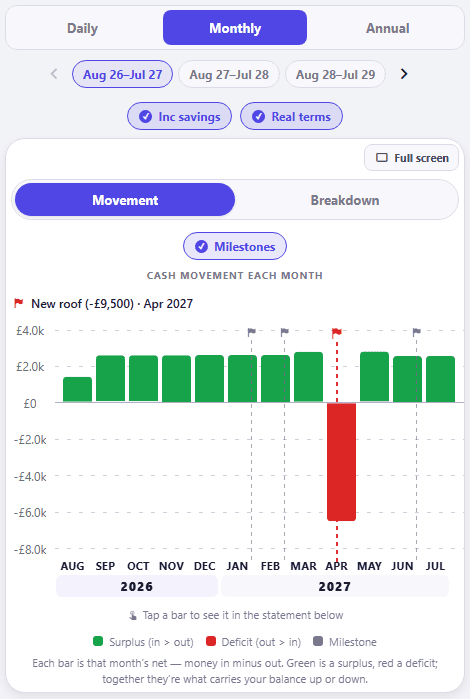
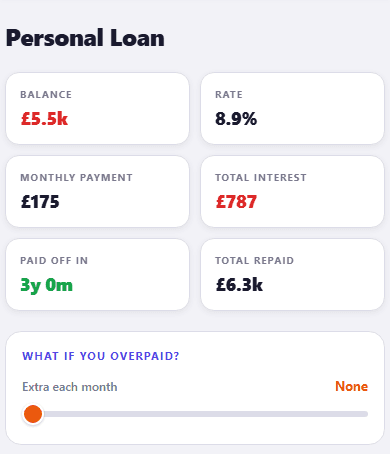
Figures shown are the sample profile, not a real household.
Which UK apps are which
One of the two words per app, with what each is for and how far ahead it looks. Every cell is from the company's own site, help centre or app listing, checked on 16/09/2026; the full comparison, with prices, is on UK money apps compared.
| App | Spending tracker or budgeting app? | How far ahead it looks |
|---|---|---|
| CrestCast | Budgeting app. Plans what you can spend now against where you are going | Ten years, day by day |
| Snoop | Spending tracker, with monthly and category limits over the feed | A bills-against-balance timeline to month end, plus a 15-year savings projection. No household cashflow forecast |
| Emma | Spending tracker, with monthly and category limits over the feed | To the end of the current month. Its True Balance nets an account against known upcoming payments |
| Plum | Spending tracker and automated saver. No feature it calls a budget | A goal or retirement outcome, as a number and a timeline. No month-by-month balance |
| Monzo | A bank, with a spending tracker and monthly targets built in | One figure: what is left to spend this period after upcoming payments |
| YNAB | Budgeting app for this month only. No view past month end | None, by design. It argues against forecasting in its own guides |
| PocketSmith | Budgeting app. Projects account balances from scheduled budgets | Six months to 60 years, by tier. Weekly steps beyond three months |
| Moneyhub | Spending tracker | Not applicable |
| Money Dashboard | Spending tracker | Not applicable |
All names are the trademarks of their owners. This page is independent and is not affiliated with, endorsed by or sponsored by any of them. Of the nine apps here, two budget forwards, which is why this site describes CrestCast as one of the few UK apps that does.
Why a budget that works forwards needs no bank feed
CrestCast does not connect to your bank, and the reason follows from the ladder. A feed is the right way to find out what you spent, and CrestCast is not analysing what you spent. The numbers a forward budget needs are not in a transaction history: a pay rise you have been told about, a car you plan to replace in two years, a second child. So you type the plan, which takes an evening the first time, or hand it a CSV your bank exported and let it pick out the payments that repeat. In return no credential is shared, nothing depends on a categorisation engine guessing right, and the model holds exactly what you decided. The full reasoning is here.
One at a time
Each comparison takes one app on the same two questions: Emma, Plum, Snoop, YNAB, PocketSmith and ProjectionLab. If you are leaving one of the closed apps, Moneyhub and Money Dashboard each have a page. And before any app at all, the UK personal finance flowchart sets out what order to do things in; its first step is a budget.
Common questions
›What is the difference between a budgeting app and a spending tracker?
A spending tracker connects to your bank, sorts what you spent into categories and reports on it: last month, this month so far, and a limit you can set against either. A budgeting app plans money you have not spent yet, and a budget is a plan for money you have not spent yet, so it needs a view of the future: the pay rise in April, the fix ending next June, the nursery place in September. If a tool cannot see past the end of this month, it can tell you what you spent and cap what you spend next, and it cannot tell you what you can afford.
›Is Emma a budgeting app?
Emma calls itself one, and its Budgeting section is a real budget for one month: a total, category limits, and a daily allowance until the period ends. The period, in Emma's own list, is the first to the last day of the month, the last working day, or a fixed monthly date, and everything it plans with is the current month's bank feed. On the test this page uses it is a spending tracker with a monthly budget on top. Checked against emma-app.com and its help centre on 16/09/2026.
›Is YNAB a budgeting app?
Yes, for this month. YNAB's own guidance is to plan using only the funds you have on hand right now, and its guide to irregular income has a section headed Why Forecasting Doesn't Work. You can assign money into future months, but only money you already hold. It is the honest edge case on this page: a budgeting tool by design, with no view past month end by design. Checked on ynab.com on 16/09/2026.
›Which UK budgeting apps plan ahead?
Of the nine apps this site has checked, two budget forwards. PocketSmith projects each account balance from your scheduled budgets, from six months on its free tier to sixty years on its top tier, with bank feeds. CrestCast forecasts the whole household, both incomes, the bills, the debts and the assets, ten years ahead at day level, and tells you what you can spend this month without missing any of it. ProjectionLab, which this site also compares, simulates a lifetime year by year and is not on the UK table. Checked on 16/09/2026.
›Do I need a spending tracker as well?
Often, yes. A tracker tells you what your recurring costs really are, which is exactly the figure a forward budget wants, and it does it without typing. Keep Emma or Snoop for where the money went, and use CrestCast for what you can spend and still get where you are going. Nothing needs integrating and no data passes between them.
›Does CrestCast give financial advice?
No. It shows what a decision does to your cash, your income and your net worth, and it never tells you which product or fund to buy. It does not do retirement planning either: a pension pot sits in net worth as an asset, and that is the whole of it. The top rung of the ladder is a regulated adviser, and CrestCast does not claim it.
Go deeper
- UK money apps compared →
Every app on this page with its price, what it is for, and how far ahead it looks.
- CrestCast vs Emma →
A spending tracker with a monthly category budget, next to a budget that works forwards.
- CrestCast vs YNAB →
A budget for this month only, next to one that runs ten years.
- How the forecast works →
The model behind rung three: day-level events, three statements, one clock.
- Scenario comparison →
Rung four: two versions of the plan side by side.
- Pricing →
£79.99 a year for the whole household, which is £6.67 a month.
This is not advice
This page is independent and is not affiliated with, endorsed by, or sponsored by Emma, Plum, Snoop, Monzo, YNAB, PocketSmith, ProjectionLab, Moneyhub or Money Dashboard. Every statement about another product was checked against that company's own site, help centre or app listing on 16/09/2026and may be out of date by the time you read it. Nothing here is financial advice.
Most budgeting apps tell you where your money went. CrestCast shows you where it is going.
Both incomes, the bills, the mortgage and the children in one forward budget, ten years out, so you know what you can spend this month and still get where you are going.
Try CrestCast free →30-day free trial, no card needed to start · 14 days to change your mind after you pay