Managing Joint Finances as a Couple: Why Both Partners Need the Same Picture
In most couples, one person carries the financial knowledge. They know the mortgage rate, the pension contributions, what the joint account actually covers. This is why that's a risk, and what a shared model actually looks like.
Ask most couples who knows the mortgage rate, when the fixed deal ends, or exactly what the joint account covers each month, and you'll usually get one name. It's a common pattern. One person just ends up doing the admin, and the knowledge concentrates with them.
The hidden risk of one person carrying it all
The problem isn't the split of the work. It's that it creates a real vulnerability. If that partner becomes unavailable, whether through illness, a busy period at work, or a separation, the other is left making decisions from a partial picture at exactly the moment they can least afford to. It also leaves the one who does keep it holding the whole picture in their head, alone. Both partners should be able to see the financial future, not only the one who logs into the mortgage portal.
What 'joint' usually means in practice
Most couples have a joint account for shared bills, which feels like joint finances but usually isn't. It covers the visible, recurring costs (rent or mortgage, utilities, groceries) while each partner's individual salary, pension, savings, and debts sit outside it, known in full only to them. The joint account is a bill-splitting tool, not a shared financial model.
One household model, whoever keeps it
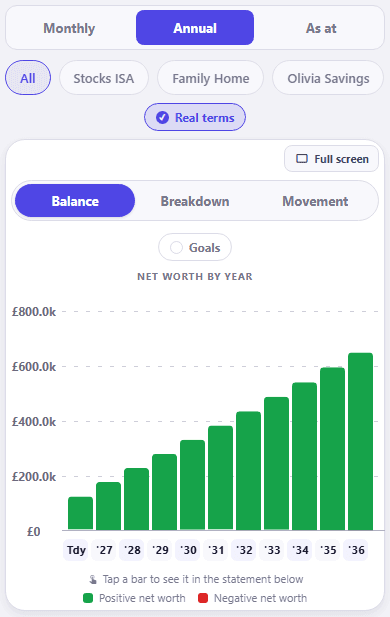
CrestCast's joint household view combines both partners' income, shared bills, joint account contributions, and individual debts and assets into a single forecast: one combined P&L and net worth picture that both people can see.
What changes when both partners can see it
The practical effect shows up when a decision lands: a job change, a house move, a second child, a career break. Instead of one partner reconstructing an hour of workings from memory, whoever keeps the model can open a chart, show the path, and the decision gets made in minutes, because you are both reading the same numbers. And keeping the model stops meaning carrying it alone: the full picture is simply there for your partner to read whenever they want, without having to run any of it.
Reading without running anything is a real access level, not just a habit. A partner you invite starts with viewing access: everything shared is theirs to read, their own details stay theirs to edit, and nothing they tap can change the shared plan, so opening the app never carries the worry of accidentally moving something. It settles the other side too: whoever keeps the model knows it only changes when they change it. And when you would both rather edit, viewing and editing is one setting, yours to change at any time.
A shared model raises a fair question, which is what happens when one of you changes something and the other is looking at the result a week later. CrestCast keeps a change history: what was edited, on which item, from what to what, when, and which of you did it. Recent changes by your partner surface on the home screen rather than waiting to be found, and the full history is a screen you can open at any time. Neither of you has to remember to mention a new bill, and when a figure looks different from last week, the entry that changed it is there to read.
›How to check this
This is CrestCast's own Net Worth screen in the Combined (household) view, showing the demo household rather than anyone's real figures.
No scenario was modelled or changed; the demo household's default forecast is shown as-is, on the annual view with the Real terms toggle on, so every bar is stated in today's money.
The same numbers, whoever keeps them
One shared household forecast, with joint and personal money kept separate but added up, and one subscription covering you both.
30 days free, no card. Then £7.99 a month or £79.99 a year for the whole household.
Put your own numbers in and see the next ten years.
30 days free, no card. Then £7.99 a month or £79.99 a year for the whole household.