Why I built CrestCast
Most of us manage money by looking backwards. I built CrestCast to change that, bringing the same forward-looking tools that businesses rely on to your household.
Most businesses of any size run on three financial statements: a profit and loss account, a balance sheet, and a cashflow forecast. Together they answer three questions every organisation needs to know: are we making money, what are we worth, and can we pay our bills? The answers shape every decision the business makes.
Most households have none of this. At best, a spending tracker that tells you what you spent last month. At worst, a vague sense that the money comes in and the money goes out, with a hope that it's roughly working.
The problem with spending trackers
Spending trackers are built around the past. They pull in your transactions, categorise your spending, and tell you whether you were over or under the limit last month. That's useful, but it doesn't answer the questions that actually matter when you're making financial decisions. A budget is a plan for money you have not spent yet, and you cannot make one with no view of the future.
What will our net worth be in 10 years? When does the mortgage clear? If we had another child, what would that do to our finances? If one of us took a career break, how long could we manage? These questions need a forecast, not a transaction history.
One person carrying all the knowledge
There's another problem I kept seeing: in most couples, one person carries all the financial knowledge. They know the mortgage rate, the pension contributions, when the fixed rate ends, what the joint account actually covers. The other partner has a rough idea but not the full picture.
That's not a good place to be making decisions from, and it creates a real vulnerability if circumstances change. Both partners deserve to understand their financial future.
What CrestCast is
CrestCast gives your household a proper financial model. Enter your income, your bills, your assets and debts, and the app builds a forward-looking picture of your P&L, your net worth trajectory, and your day-by-day cashflow. Both partners can see the same picture, model decisions before making them, and track progress over time. And seeing it never has to mean running it: a partner can hold viewing access, the default when they join, so the whole picture is theirs to read and nothing they tap can change the plan.
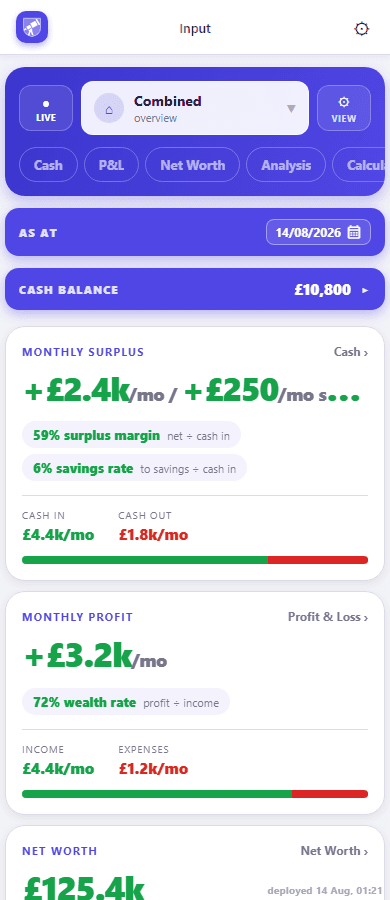
It's built entirely for UK finances: income tax, National Insurance, student loan plans and pension contributions, all calculated correctly so the numbers you see are the numbers you'll actually live with.
I built it because I wanted it myself. I think you will too.
For a worked example of the app actually being used to compare a decision, see "Comparing Financial Scenarios Before You Decide" or any of the "Should I..." posts on this blog.
›How to check this
The screenshot above is the app's own Plan screen for the demo household, before any single statement is opened, so the figures in it are the demo's rather than anyone's real ones. All three figures are computed from the same set of inputs, which is the point the post is making.
Build your household's first forecast
Income, bills, debts and savings in once; your cashflow, profit and loss and net worth ten years out. Describe your money in plain English and a working forecast takes under an hour.
30 days free, no card. Then £7.99 a month or £79.99 a year for the whole household.
Put your own numbers in and see the next ten years.
30 days free, no card. Then £7.99 a month or £79.99 a year for the whole household.