Doing it yourself
A self-directed alternative to a financial adviser
Paying someone a percentage of your assets every year, forever, is one way to plan your finances. It is not the only way, and for a lot of UK households it is not even an available one. This page sets out what advice actually costs, who can get it, when it is genuinely worth paying for, and where running the numbers yourself is enough.
Read this first
CrestCast is not a financial adviser. It is not authorised to give regulated financial advice and it makes no recommendations. It models the numbers you give it and shows what they lead to. It will never tell you to buy a product, move a pension, or pick one investment over another. Where a decision is complex or irreversible, get regulated advice.
| CrestCast | Ongoing financial advice | |
|---|---|---|
| What it is | A planning tool you run yourself | An FCA regulated professional making personal recommendations |
| Regulated advice | No. CrestCast is not a financial adviser and makes no recommendations | Yes. What an adviser recommends has to be suitable for you |
| What it costs | £7.99 a month or £79.99 a year, covering the household | FCA research put average charges at 2.4% of the amount invested up front and 0.8% a year ongoing, before product and platform charges |
| Cost as your money grows | The same whatever your finances are worth | Rises with the portfolio. At the FCA average of 0.8%, £250,000 is about £2,000 a year |
| Who can get it | Anyone | Industry research found just under two thirds of firms set a minimum asset requirement, and where a firm named a figure the average was £276,000 |
| What it is good at | Modelling your own numbers forward and testing a decision before you make it | Product and wrapper selection, pension transfers, inheritance tax, and talking you out of a bad decision |
| If it goes wrong | The decisions are yours, and so is the responsibility | You can complain, and escalate to the Financial Ombudsman Service |
Adviser cost figures are from the FCA's December 2020 evaluation of the Retail Distribution Review and the Financial Advice Market Review, and from Unbiased, checked 30/07/2026. Minimum-asset figures are from the lang cat's Advice Gap 2025 research, which surveyed advice firms, not from the regulator. Costs vary widely between firms.
What advice actually costs
The regulator has measured this. In its December 2020 evaluation of the Retail Distribution Review, the FCA found average adviser charges of 2.4% of the amount invested for initial advice and 0.8% a year for ongoing advice. It then said something most fee discussions skip over: that figure does not include the underlying product and portfolio charges, which averaged another 1.1% a year. Put together, the FCA's figure for the all-in annual cost of holistic advice was 1.9% a year.
Percentages are slippery, so convert them. At the FCA's average ongoing charge of 0.8%, a £250,000 portfolio costs around £2,000 a year in adviser fees alone, and a £500,000 one around £4,000. Those are our sums on the regulator's percentage, not the regulator's own worked example. The point is not that the fee is outrageous. The point is that it is a fee that grows every year your money does, whether or not the work that year grew with it.
Checked on 30/07/2026, Unbiased quoted £100 to £350 an hour, £2,000 to £3,000 for initial advice on portfolios up to £100,000, and ongoing charges commonly between 0.5% and 1%.
And whether you can get it at all
The bigger problem for most households is not the price, it is access. Research published by the lang cat in 2025 found just under two thirds of advice firms operate a minimum asset requirement, and among firms that name a specific number the average was £276,000, with £100,000 the most common answer. Most of those firms said they would not flatly turn someone away, but a service designed around a quarter of a million pounds is not a service designed around a mortgage, two salaries and a childcare bill.
The FCA's Financial Lives survey, published in May 2025 from fieldwork to June 2024, found 8.6% of UK adults, about 4.6 million, had taken regulated financial advice in the previous 12 months, while 29%, about 15.8 million, had not but may have needed support. In December 2025 the FCA put it plainly: around 23 million consumers are currently underserved by the markets for advice and guidance, and the advice gap is real.
The same survey found 68% of adults would pay for advice if the costs were reasonable, but only 37% felt they understood what advice costs. Offered a hypothetical £100,000 windfall, 63% said they would make the decision themselves with no advice or guidance at all, up from 52% in 2020. Self-directed is not a fringe position. It is what most of the country is already doing, usually with a spreadsheet and a hope.
When you should pay an adviser anyway
On the right problems, advisers earn their money. Get regulated advice when the decision is complex, irreversible or heavily tax-driven: a defined benefit pension transfer, drawing an income from a large pot, inheritance tax planning on a substantial estate, or anything where the sequence and the wrapper matter more than the arithmetic. Unbiased puts the average fixed fee for that work at around £8,550 for a defined benefit transfer, £6,700 for at-retirement advice on a £500,000 pot and £8,995 for inheritance tax planning on a £1m estate. Against the cost of getting any of those wrong, that is not expensive.
Advisers also do something no software does. Vanguard's 2025 UK study of adviser value put behavioural coaching, which mostly means stopping people selling at the bottom, at up to 200 basis points, the single largest component of its estimate that good advice can add up to or more than three percentage points of net return. Read that figure carefully: Vanguard says it is three percentage points over an unspecified period, not per year, and Vanguard is a fund manager estimating the value of the channel that sells its funds. Even discounted heavily, the behavioural point stands. People are terrible at holding their nerve, and a good adviser is worth paying to be the person who tells you to do nothing.
And satisfaction among people who do pay is high. The lang cat found 93% of those who had paid for advice found it helpful. If you can get it, can afford it, and have a problem worth it, get it.
Where a planning tool is enough
A great many household decisions are not investment decisions at all. Should we overpay the mortgage or build the savings. What does one of us dropping to four days actually do to the next five years. Can we afford the bigger house, and what does it cost us in ten years if we buy it. When is this debt gone. Those are arithmetic and consequence, not product selection, and you do not need to hand over a percentage of your assets to answer them.
CrestCast is built for exactly that. It takes your household's real numbers, both incomes, joint and personal accounts, the mortgage, the debts, the children, and projects them forward as a three-way model: cashflow, profit and loss, and net worth, all reconciling to each other. You get the date each debt clears, the ability to pin what really happened so the forecast re-reckons from it, and the option to save two versions of the plan and compare them side by side. One subscription covers the household, so both of you are looking at the same numbers.
The point of it is not a conclusion handed to you. It is knowing where your household is headed, and being the one who decides what to do about it.
Two versions of the plan, side by side
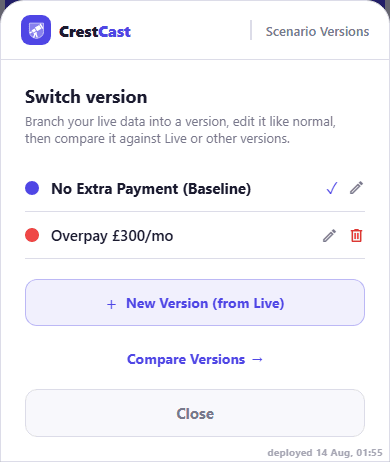
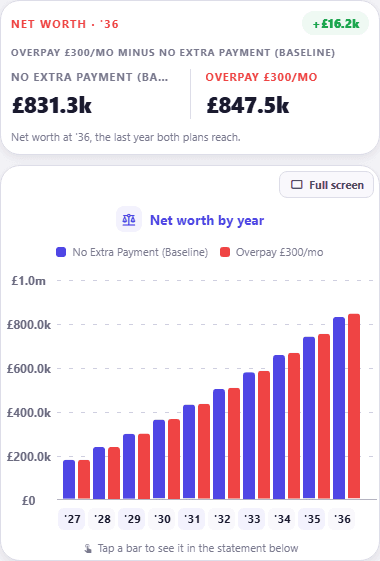
Figures shown are the sample profile, not a real household.
If you want a sensible order to work through the decisions in the first place, the UK personal finance flowchart is a good free starting point, and pension or ISA first covers one of the questions people most often pay to have answered.
Where the line sits, precisely
This matters enough to be exact about. Under the FCA Handbook, advice requires an element of opinion, in effect a recommendation as to a course of action. Simply giving information, without comment or a value judgment on its relevance to a decision you might make, is not advice. A personal recommendation goes further still: it concerns a particular investment and is either presented as suitable for you or based on a consideration of your circumstances.
CrestCast does none of that. It does not look at any particular investment, does not compare products, does not filter or select on your behalf, and never tells you what you should do. It shows you what your own numbers imply under assumptions you set. That is information about your money, which is why CrestCast is a planning tool and not a regulated adviser.
For free, impartial guidance backed by government, MoneyHelper is the right place to start, and the FCA Financial Services Register is where to check that anyone calling themselves an adviser actually is one.
Common questions
›Is CrestCast a financial adviser?
No. CrestCast is not a financial adviser, is not authorised to give regulated financial advice, and does not make recommendations. It models the numbers you give it and shows you the consequences of choices you specify. It will never tell you to buy a particular fund, move a pension, or pick one product over another. If you want a personal recommendation that has to be suitable for you, that is a regulated adviser, and this is not a substitute for one.
›What does a financial adviser cost in the UK?
The most authoritative figures come from the FCA. Its December 2020 evaluation of the Retail Distribution Review found average adviser charges of 2.4% of the amount invested for initial advice and 0.8% a year for ongoing advice, and said explicitly that this excludes underlying product and portfolio charges. Adding those in, the FCA put the average all-in cost of holistic advice at 1.9% in charges each year. Unbiased, checked on 30/07/2026, gives £100 to £350 an hour, £2,000 to £3,000 for initial advice on portfolios up to £100,000, and ongoing charges commonly between 0.5% and 1%.
›Can I get financial advice with a small portfolio?
It is harder than it used to be. Research by the lang cat published in 2025 found just under two thirds of advice firms have a minimum asset requirement, and among the firms that name a specific figure the average was £276,000 with the most common answer £100,000. Most firms will not simply turn you away, but the practical effect is that services are shaped around larger portfolios. The FCA has said around 23 million UK consumers are currently underserved by the markets for advice and guidance.
›When is a financial adviser genuinely worth paying for?
When the decision is complex, irreversible, or tax-heavy. Defined benefit pension transfers, drawing an income from a large pension pot, inheritance tax planning on a substantial estate, and anything where getting the wrapper or the sequence wrong costs more than the fee. Unbiased puts average fixed fees for that kind of work at around £8,550 for a defined benefit transfer, £6,700 for at-retirement advice on a £500,000 pot and £8,995 for inheritance tax planning on a £1m estate, which sounds like a lot until you consider what a mistake on any of those costs. Advisers also do something software cannot: they talk people out of panicking.
›Is using a planning tool the same as getting advice?
No, and the distinction is a regulatory one, not marketing. The FCA Handbook says advice requires an element of opinion, in effect a recommendation as to a course of action, and that simply giving information without any comment or value judgment on its relevance to a decision is not advice. A tool that projects your own household numbers forward, and shows what happens under the assumptions you choose, is giving you information about your own money. It is not assessing whether a particular investment is suitable for you, because it never looks at one.
›What is the FCA targeted support regime, and does it change this?
Targeted support is a new regulated activity that came into effect on 6 April 2026. It lets authorised firms make suggestions designed for groups of people with common characteristics, sitting between generic guidance and full personal advice, and it is limited to defined contribution pensions and retail investments. A speech by the FCA in July 2026 reported seven firms already approved and more in the pipeline. It is a promising development, and it is worth watching. It does not change what CrestCast is: targeted support requires FCA permission and involves making suggestions, and CrestCast makes none.
›Do I still need an accountant or a solicitor?
CrestCast does not replace either, any more than it replaces an adviser. It is a planning tool. Tax returns, wills, trusts and probate are all professional work, and this does none of them.
Where to go next
- The UK personal finance flowchart →
The order to do things in, before you pay anyone to tell you the order to do things in.
- CrestCast vs PocketSmith →
The one comparison where both products forecast. It has bank feeds; we make the case for not having them.
- CrestCast vs YNAB →
The envelope budget against the forward forecast, and why they are not the same tool.
- CrestCast vs Lumio →
A bank-connected app for couples, next to a household forecaster that connects to nothing.
- CrestCast vs Money Dashboard →
Money Dashboard's apps closed in 2023. What UK users lost, and what replaces which part of it.
This is not advice
CrestCast is not a financial adviser and nothing on this page is financial advice or a personal recommendation. Adviser cost and market figures are drawn from the FCA's December 2020 RDR and FAMR evaluation, the FCA's Financial Lives 2024 survey published May 2025, FCA Policy Statement 25/22, the lang cat's Advice Gap 2025 research, Unbiased and Vanguard, all checked on 30/07/2026. Where a pound figure is our own arithmetic on a published percentage, the page says so. Charges vary widely between firms and change over time, so check current figures before relying on any of them. If you are unsure what to do, speak to a regulated financial adviser.
Run the numbers yourself, properly.
CrestCast forecasts your household's cashflow, profit and loss and net worth, shows when your debts clear, and lets you compare two versions of the plan before you commit to either.
Try CrestCast free →14-day free trial, no card needed to start · Cancel any time