Should I Upsize My Home?
Upsizing feels like progress. More space, a better location, room for the family to grow. But more property means more debt and a cashflow hit that can last years. Here's how to think it through properly.
This article represents a personal view and is not financial advice. Every household's circumstances are different, so please consider your own situation carefully before making any significant financial decisions.
The upsizing conversation usually starts the same way. The house feels small. A new child is on the way, or already here and growing fast. Someone mentions their place has doubled in value. You start browsing property listings at night, half-dreaming. It feels like the obvious next move.
And it might be. But the obvious next move is not always the right one, and it deserves a closer look before you commit.
More House, More Exposure
When you upsize, you're buying more than extra space. You're increasing your exposure to the property market. If prices rise, your larger asset grows in value. That can look compelling on paper, particularly when you see headlines about house prices outpacing other asset classes.
A few things are worth sitting with, though. Property price growth is usually quoted in nominal terms, and adjusting for inflation changes the picture. Over the long run UK house prices have risen by roughly 3 to 4% a year in nominal terms (Nationwide House Price Index), while consumer price inflation has averaged around 2 to 3% a year over the past two decades (ONS Consumer Price Inflation). Strip inflation out and the real return has often been low, and in some stretches barely positive. Treat those as long-run averages that hide enormous variation, not a rate you can count on: nominal growth has swung from double digits in boom years (over 13% in mid-2022) to outright falls (2023), and it differs sharply by region (London and the South East have behaved very differently from the North East or Northern Ireland) and by property type, with flats and houses diverging noticeably since 2016. Over comparable periods a well-diversified index fund has historically delivered higher real returns, with lower transaction costs and no stamp duty. Past performance is no guarantee of future returns.
Property does have one genuine edge the headline rate hides: leverage. You rarely buy a house with cash. You put down a deposit and borrow the rest, so price movements apply to the whole property value while only your deposit is your own money in the game. Put £50,000 down on a £250,000 home and a 4% rise adds £10,000: a 20% gain on your deposit, not 4%. That amplification is real, and it is part of why property can build equity faster than an unleveraged fund. But it runs in reverse just as hard. The same 4% fall takes a fifth of your deposit with it, and a steeper fall can tip you into negative equity, owing more than the home is worth.
Leverage is not free, though, and its price is your mortgage rate. That rate is the hurdle the property has to clear before the borrowing works for you rather than against you. When your mortgage rate sits above the pace at which prices are rising, the interest you pay can quietly outrun the extra value the borrowing buys. That has been the position for much of the period since 2022, with fixed deals commonly around 4 to 5% or higher against long-run nominal growth nearer 3 to 4%. Upsizing sharpens both edges of this: a bigger mortgage means more leverage if prices climb, but also a larger interest bill to cover every month whatever prices do.
Stamp Duty Land Tax is a significant and often underestimated cost. Since April 2025 the nil-rate threshold in England and Northern Ireland is back down at £125,000 for home movers (Scotland and Wales run their own equivalents), so almost any upsize purchase attracts duty, and at higher price points it adds up quickly. On the £450,000 purchase modelled below it is £12,500, and with agent, solicitor and removal fees the move costs £20,625 to make. Unlike the deposit, none of that is recovered when you eventually sell.
The Cashflow Problem
This is where upsizing gets genuinely complicated, and where many households find themselves surprised. A larger mortgage means larger monthly payments. That's obvious. Less obvious is the cumulative effect: higher energy bills, higher council tax, more maintenance, higher insurance. The gap between your current monthly outgoings and your post-upsize outgoings is often substantially larger than just the mortgage difference.
If that gap leaves you cashflow negative, spending more than comes in each month, that isn't a short-term problem you can wait out. It's a structural one that persists until either your income rises significantly, the mortgage term progresses, or you sell. This is worth modelling carefully before you commit. Not just the mortgage repayment, but the full picture: bills, maintenance, the deposit you're deploying. CrestCast shows you what your cashflow looks like month by month in both scenarios, upsizing versus staying, so you can see clearly what you're signing up for.
Take a real household we modelled: a £295,000 house with a £182,000 mortgage at 5.2%, weighed against a £450,000 house. Follow the money through the move rather than assuming it. Sell at £295,000, pay the estate agent £4,425, the solicitors on both transactions £2,500, the removal firm £1,200 and £12,500 of stamp duty, then settle the old £182,000 mortgage. That leaves £92,375 to put into the new house, so the mortgage becomes £357,625 at 5.5%. Add the higher council tax and bigger gas and electric bill that come with the extra square footage. Same income, same everything else, just the one decision changed.
Before any of that, it is worth being precise about the payment the bigger mortgage would actually carry. The mortgage affordability calculator works it either way round: the monthly cost of a given mortgage, or the amount a monthly budget you are comfortable with can realistically borrow.
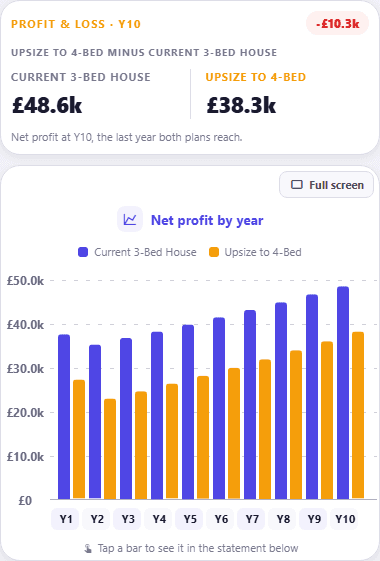
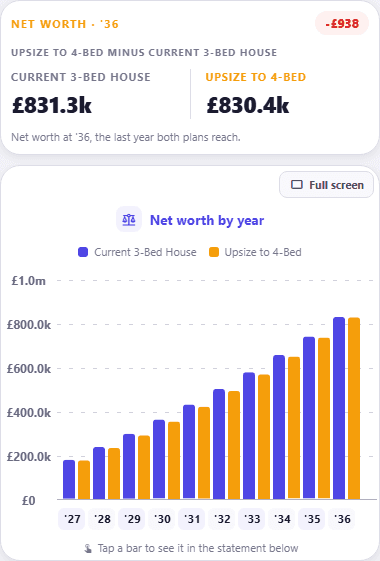
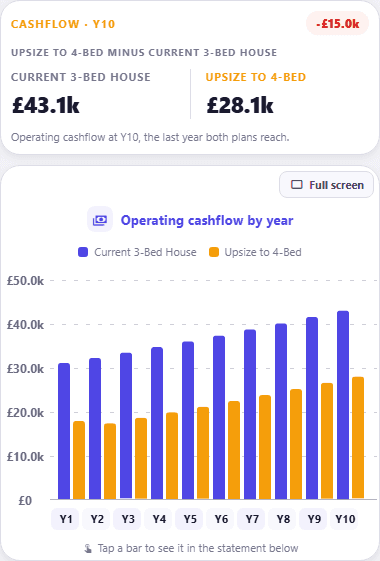
By year ten in this example, staying put is ahead on all three measures. Net profit is £35.4k against £27.0k and operating cashflow £29.4k against £15.1k, so the upsize costs roughly £8.5k a year of profit and £14k a year of cash. Net worth in 2036 is £789.6k against £703.6k in future pounds, a gap of £86.0k. The bigger house genuinely is worth more on paper and it grows with the market like any other property, and it still does not catch up: the interest on the extra £175,625 of mortgage, plus the £20,625 the move costs to make, outruns the extra growth over this horizon. A bigger asset does not automatically mean a bigger net worth. It can mean a smaller one, bought with a great deal less cash in hand every month, which is the cost this decision is actually made of.
It is worth being clear about which part of that gap is the stamp duty, because it is the part people leave out. Model the same move with no transaction costs at all, the way an estate agent's arithmetic tends to, and the ten-year net worth gap is £47.4k rather than £86.0k. So about £39k of the shortfall traces back to £20,625 that changed hands on completion day: the money itself, plus a decade of the interest on the extra borrowing it had to be funded from. Transaction costs on a house are not a rounding error, and they do not sit still.
›How to check this
This example uses CrestCast's demo household as a starting point, with the Live data renamed to "Current 3-Bed House" and a branched "Upsize to 4-Bed" version created from it. You can open the same household at crestcast.app/?demo=1 and rebuild the branch yourself.
The new mortgage is derived, not chosen. Equity is £295,000 less the £182,000 mortgage, so £113,000. Moving costs are £4,425 of estate agent fees (1.5% of the sale price, including VAT), £2,500 of solicitor fees across both transactions, £1,200 of removals and £12,500 of Stamp Duty Land Tax on a £450,000 purchase at the England and Northern Ireland mover rates in force since April 2025: £20,625 in total. That leaves £92,375 towards £450,000, so the branch carries a £357,625 mortgage. No cash moves in or out of the household's accounts on the move, which is what makes the two branches comparable.
Three things changed on the branch: the property value (£295,000 to £450,000), the mortgage (£182,000 to £357,625 balance, 5.2% to 5.5% rate, same 24-year term), and two bills that scale with a bigger home (Council Tax £142 to £178/mo, Gas & Electric £110 to £148/mo). Income, other assets, and everything else were left untouched, so the comparison isolates the effect of the property decision itself.
Growth rates in CrestCast are real rates, meaning growth above inflation. The demo household's property grows at 3% above inflation, with inflation set at 2.5%. That is a generous assumption for house prices, and it runs in the upsize's favour rather than against it, because the bigger house is the one compounding on the larger number. The paragraph above about long-run real house price growth is the reason to treat the result as a best case for moving rather than a worst one. Change the rate in Settings and the whole comparison re-runs.
The £47.4k figure quoted above for a move with no transaction costs is the same branch with the mortgage left at £337,000, which is £182,000 plus the £155,000 of extra house and nothing else. It is quoted to size the cost of moving, not as a scenario anybody can actually buy.
The charts show the Household view (both partners' finances combined) over a 10-year forecast, comparing the two branches via CrestCast's Compare Versions screen, in nominal money rather than today's money. Both branches run with the same inflation and asset-growth assumptions, including growth on the property itself, so the bigger house is not penalised by being modelled as a static asset.
But Is the House Worth It?
Sometimes the cashflow hit is real and the move is still the right call. A house that gives your children a proper garden, a bedroom each, a neighbourhood with good schools within catchment, shorter commutes, and proximity to family offers genuine and lasting value that doesn't appear in a financial model.
The question isn't just "can we afford this?" but "is what we're gaining worth what it costs us?" Some questions worth asking yourself:
- Does the new location improve daily life beyond the house itself? Better schools, shorter commute, closer to family, better green space, safer neighbourhood?
- Is the cashflow hit temporary, with income you expect to grow in the next few years, or does it require sustained, open-ended sacrifice?
- Are you buying at a price that leaves financial headroom, or would a rate rise or a period of reduced income create real pressure?
- Is there a meaningful difference in the quality of the property (layout, garden, condition, light), or are you paying mainly for size?
- What happens to your savings rate? If upsizing means you stop saving entirely for several years, what does that do to your pension, your emergency fund, your broader financial resilience?
- Have you stress-tested the numbers? What does the mortgage look like if rates rise by 1% or 2%? Can you still manage?
The Right Way to Think About It
Upsizing isn't inherently good or bad. It's a trade: you give up cashflow and flexibility in exchange for more housing and greater property exposure. Whether that trade is worth it depends entirely on your circumstances, your income trajectory, and what the new house actually does for your life.
The mistake is to treat it as a foregone conclusion because it feels like progress.
Run the numbers, model both paths side by side, and then make the decision with your eyes open, not just to what you're gaining but to what you're giving up.
Price the bigger house in years, not just monthly payments
Branch a version with the larger mortgage and the higher bills, and see what the move does to your cashflow and net worth over the next decade before you offer.
30 days free, no card. Then £7.99 a month or £79.99 a year for the whole household.
Put your own numbers in and see the next ten years.
30 days free, no card. Then £7.99 a month or £79.99 a year for the whole household.
Open the £450,000 move in a sample household's forecast. Open the sample forecast →