Should I Overpay My Mortgage? A UK Example
Overpaying your mortgage reduces interest and builds equity faster. But it also locks money away in property. Whether it's the right move depends on what else that money could be doing.
This article represents a personal view and is not financial advice. Mortgage terms vary, so always check your lender's overpayment rules before making additional payments.
Overpaying your mortgage is one of the tidiest financial decisions available. The maths is simple, the benefit is guaranteed, and the emotional case (less debt, more security) is compelling. But like most financial decisions, whether it's the right call depends on what else you could do with the same money.
Try the interactive overpayment calculator
Drag an overpayment slider and watch the years knocked off your term, the interest saved, and the hit to your monthly cashflow update live. No sign-up needed.
Open the calculator →What Overpaying Actually Does
Every extra pound you pay reduces your outstanding mortgage balance. A lower balance means less interest charged next month. Less interest means more of your standard repayment goes to capital. The effect compounds over time, particularly when you overpay early in the mortgage term, because you reduce the balance for the longest remaining period.
The guaranteed return on an overpayment is equivalent to your mortgage interest rate. If your rate is 4.5%, overpaying is like earning a known 4.5%, at the cost of access to the money, which compares with what cash savings pay.
The easiest way to feel that return is as time rather than a percentage. Your payment stays the same while the balance falls faster, so the mortgage simply ends sooner. The calculator above leads with the years knocked off, then shows the interest behind them. A worked example:
£200,000 at 5% over 25 years, £200 a month extra
6 years 2 months sooner
- Monthly payment
- £1,169.18 to £1,369.18
- Interest you never pay
- £41,843
The mechanics behind that, how each payment splits between interest and capital and why early overpayments punch above their weight, are worked through in How a Loan Works.
Check for Early Repayment Charges
Before overpaying, check your mortgage terms. Most lenders on fixed-rate deals allow overpayments of up to 10% of the outstanding balance per year without penalty. Exceed that and you may face an Early Repayment Charge, which can be significant. On a tracker or variable rate mortgage, restrictions are usually lighter.
The Alternatives Worth Comparing
The key question is what else the money could do. Three main comparisons:
- More expensive debt: a credit card at 22.9% or a personal loan at 8.9% costs you more every month than a 5.2% mortgage saves you. Clearing those first is the one comparison where the answer is not a judgement call.
- Pension contributions: if you're not already maximising your employer match, pension contributions come first, since the match is free money that overpaying can't compete with. Higher rate taxpayers also get 40% tax relief, making pensions highly efficient.
- Stocks and Shares ISA: over long periods (10+ years), equity index funds have historically returned more than most mortgage rates. But past performance is not a guide to future returns, whereas overpaying saves you a certain amount of interest.
- Cash savings or emergency fund: if you don't have 3 to 6 months of expenses accessible, build that first.
The Illiquidity Problem
This is the most important practical consideration. Money paid into your mortgage is hard to get back. You can't simply ask the lender to return it in an emergency. To access the equity you'd need to remortgage or sell, and that's a meaningful constraint if your circumstances change.
An ISA, by contrast, is fully accessible. If you save into an ISA and something goes wrong, you have options. This flexibility has real value for any household, and especially once children are in the picture, when unexpected costs stop being the exception and become the norm.
When Overpaying Makes Most Sense
- Your mortgage rate is relatively high (above 4 or 5%) and your investment alternatives feel uncertain.
- You already have a solid emergency fund and are maximising your employer pension match.
- You are approaching the end of a fixed rate deal and want to reduce the balance before remortgaging, since a lower loan-to-value can unlock better rates.
- The psychological benefit of reducing your debt matters to you. There's genuine value in sleeping better, even if a spreadsheet says otherwise.
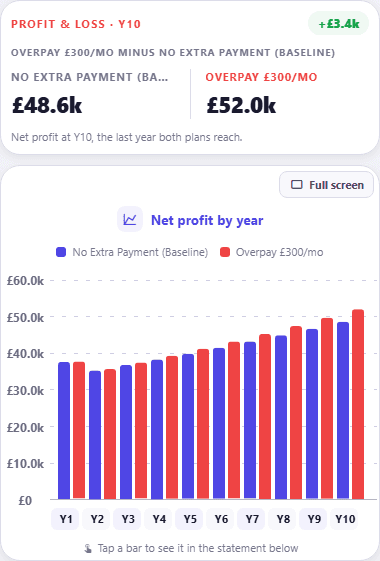
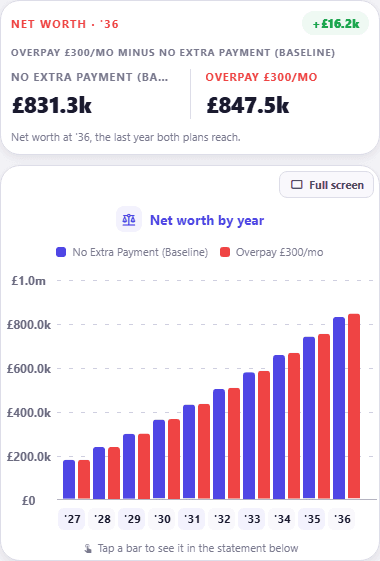
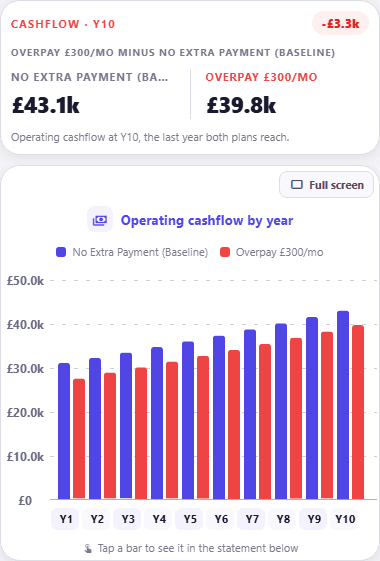
By year ten, the overpaying branch's operating cashflow is lower, £27.9k against £29.4k for the baseline, because that £300/month is real money leaving the account every month, same as any other bill. The P&L moves the other way, £37.3k of net profit against £35.4k, because the interest the overpayment removes was a genuine expense and no longer gets charged. So far, so expected. The net worth chart is where this household surprises you: overpaying finishes £10.0k behind, and it is behind in every single year of the forecast, from about £60 down in the first year to £10.0k down by 2036.
The reason is a different comparison from the first one in the list. This household's spare cash does not go at its debts. The demo's spare-cash waterfall sends whatever the current account holds above a £1,000 buffer into a Stocks ISA, and over the ten-year forecast it routes nothing to the credit card, the loan or the mortgage: the loan and the balance transfer card run off on their own schedules, the 22.9% card is paid at its minimum, and the mortgage keeps its standard payment. So the £300 a month is not new money. It comes out of spare cash the plan would otherwise have saved, in an ISA assumed to grow at 7% above inflation against 5.2% on the mortgage. Switch the waterfall off, so that cash would otherwise pile up in a current account earning nothing, and the identical overpayment is worth £9.7k more by 2036 rather than £10.0k less. Nothing about the mortgage changed between those two runs. What changed is what the money would otherwise have done.
That is the answer to the question in the title, and it is not the one the arithmetic on its own gives. A guaranteed 5.2% is a good return in isolation, and it wins against cash doing nothing. Here it loses to an ISA the plan was already feeding, but the ISA's 7% is an assumption and the mortgage's 5.2% is a contract, so the result describes those assumptions rather than promising an outcome. The overpayment is not wrong. Whether it wins depends on what the money would otherwise have done, and the only way to see that is to run the whole household rather than the one debt.
›How to check this
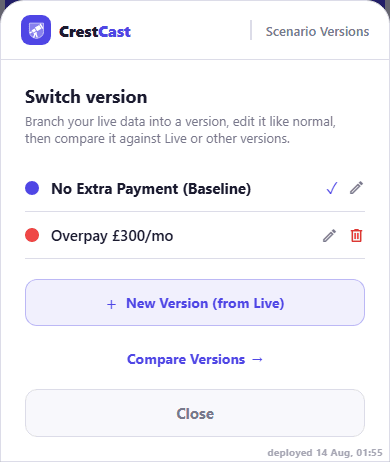
This example uses CrestCast's demo household as a starting point, with the Live data renamed "No Extra Payment (Baseline)" and a branched "Overpay £300/mo" version created from it.
Only one thing changed on the branch: the existing mortgage gained a recurring £300/month overpayment on top of its standard payment. Everything else (income, other bills, other assets) is identical between the two branches, so the comparison isolates the effect of the overpayment itself.
The result turns on one setting, so open it yourself and check. The demo household has a spare-cash waterfall switched on, built from the UK personal finance flowchart: on the personal account, whatever is above a £1,000 buffer goes into the Stocks ISA, and the joint account lists its debts with the 5.2% mortgage last. In this forecast no spare cash reaches a debt, so what the £300 displaces is the ISA saving. That is why the overpayment finishes £10.0k behind. Turn the waterfall off, so the surplus would sit in the current account instead, and the same branch finishes £9.7k ahead. Both runs are correct; they are answers to different questions, and the one that applies to you depends on where your own spare cash goes today.
Growth rates in CrestCast are real rates, meaning growth above inflation. The demo household's property grows at 3% above inflation and its Stocks ISA at 7% above inflation, with inflation set at 2.5%. The 7% is an assumption chosen for the demo, not a forecast. Both branches carry the same assumptions, so changing either in Settings moves both bars rather than the gap between them.
The charts show the Household view over a 10-year forecast, comparing the two branches via CrestCast's Compare Versions screen. Both branches run with the same inflation and asset-growth assumptions, so the gap between the bars is the overpayment itself and not a difference in how the two were projected.
A fixed £300 a month is the simplest version of the decision, and it is not the only one. You can instead make the overpayment conditional, so that whatever is left above a balance you nominate goes at the mortgage, which means it stops of its own accord in the months you cannot afford it. Your forecast should not go overdrawn covers that rule, including the part that matters here: a routed overpayment genuinely re-amortises the debt, so the balance, the interest and the payoff date all move rather than a number being shuffled between two boxes.
Ten years is long enough to see whether overpaying or investing came out ahead, which is one of the reasons CrestCast forecasts that far and no further: Why We Forecast Ten Years, Not Thirty.
See both futures before you commit a pound
Save a version with the overpayment and one without, then read the two against each other on cashflow, profit and loss and net worth, down to the month the mortgage clears.
30 days free, no card. Then £7.99 a month or £79.99 a year for the whole household.
Put your own numbers in and see the next ten years.
30 days free, no card. Then £7.99 a month or £79.99 a year for the whole household.
Take the £200,000 example into a forecast: 5% over 25 years, £200 a month extra. Take these numbers into a forecast →