Should I Downsize My Home?
Downsizing is often framed as giving something up. But for many households it can release significant capital, cut monthly costs, and open up possibilities that a large house was quietly closing off.
This article represents a personal view and is not financial advice. Every household's circumstances are different, so please consider your own situation carefully before making any significant financial decisions.
Downsizing has a reputation problem. It sounds like retreat, a concession that the chapter of large family life is closing. Nobody fantasises about moving to a smaller house the way they dream about upsizing.
But reframe it slightly and it looks different. Downsizing is releasing capital that's sitting inert in bricks and mortar. It's reducing the costs, financial and practical, of running more home than you need. It's choosing to trade space for flexibility, or a better location, or simply a more manageable life. For many people, it turns out to be one of the better financial decisions they make.
What You Actually Gain
The most immediate gain is cashflow. A smaller property typically means a smaller mortgage, or no mortgage at all if the equity in your current home covers the purchase price. Council tax is often lower. Energy bills shrink. Maintenance costs fall. Insurance reduces. Collectively these savings can be substantial, freeing up several hundred pounds a month.
The equity released can be deployed elsewhere. Paid into a pension, invested in an ISA, used to clear other debts, or simply kept accessible as a financial buffer. Capital locked in property earns nothing liquid and gives you no options in an emergency. Capital you can access changes your position entirely.
Which of those uses is worth most is a question you can put numbers to rather than argue about. The compound interest calculator shows what the released lump would grow into if it were invested, which is the fairest comparison against leaving it sitting in the walls of a house.
The Tax Picture
One thing worth knowing: in the UK, you do not pay Capital Gains Tax on the sale of your main residence. Private Residence Relief means the gain on your primary home, however large, is generally exempt. That's a significant advantage over most other investment assets, and it makes downsizing particularly tax-efficient compared to selling other investments.
Stamp Duty Land Tax still applies to the new, smaller property you're buying. You're not exempt simply because you're downsizing. But if the purchase price is meaningfully lower than your sale price, the stamp duty will be proportionally smaller, and the net release of equity after all transaction costs (estate agent fees, solicitor fees, removals) can still be very substantial.
What You Give Up
The family home often carries meaning beyond its practical function. It's where children grew up, where memories accumulated, where extended family gathered. Leaving it involves a kind of loss that varies enormously by person but shouldn't be dismissed as mere sentiment.
Location is the other major factor. If the only way to downsize affordably is to move to a different area, you may be trading proximity to things that matter (friends, family, community, familiar healthcare) for financial efficiency. That's a real trade-off and worth taking seriously before you commit.
Questions Worth Sitting With
- Is the home genuinely too large for your current life, or does it still serve a purpose: grandchildren visiting, adult children returning, a home office, space that matters to you?
- What would you do with the released equity? Having a clear and specific answer here makes the decision feel less abstract and ensures the capital actually improves your position.
- Is downsizing driven by financial pressure or a genuine choice? Both are valid, but they lead to different decisions about timing and what you're willing to compromise on.
- Have you factored in all transaction costs? Estate agent fees, solicitor fees, stamp duty on the purchase, and removals typically add up to 3 to 5% of the purchase price.
- Does the smaller property you're considering actually suit the next chapter of your life, or does it feel like a compromise you'll regret?
- Could remortgaging or equity release achieve some of the same goals without the upheaval of moving?
Cashflow Over Net Worth
One principle is worth holding onto as you think this through: as you move through life, the balance tips from net worth to cashflow. In your thirties and forties you're building. Later on, what matters most is whether money comes in each month, not what a property might theoretically be worth if you sold it. Downsizing is a direct way of rebalancing that equation.
Run both scenarios properly. What does your monthly cashflow look like in each case? What does your net worth look like across ten and twenty years? What options does each path leave you with? The numbers are the starting point. But the life you want to live is the actual question.
Take a real household we modelled: a £295,000 house with a £182,000 mortgage at 5.2%, against moving to a £190,000 property. Follow the money through the move rather than assuming it. Sell at £295,000, pay the estate agent £4,425, the solicitors on both transactions £2,500, the removal firm £1,200 and £1,300 of stamp duty on the new place, then settle the old £182,000 mortgage. That leaves £103,575 to put into a £190,000 purchase, so the new mortgage is £86,425, at a better 4.8% rate because the loan-to-value is so much lower. Add the smaller Council Tax and energy bills a smaller home brings, and nothing else changes.
Notice what the release is here, and what it is not. Nothing lands in an investment account. The capital comes out as £95,575 less mortgage, and that is where its value sits, because the debt it retires was costing 5.2%. Taking £35,000 out as a lump to invest instead is a real option, but it means carrying a £121,425 mortgage rather than an £86,425 one. That is a decision to stay in debt in order to hold an investment, and it should be priced as one rather than treated as something the move hands you for free.
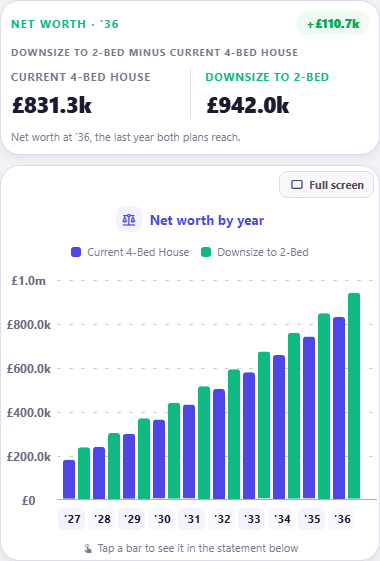
That net worth chart is the part worth slowing down for, because it says something the cashflow chart cannot. Downsizing puts this household behind for six years. Net worth at the end of year one is about £155k on the branch against about £165k for staying put, and the two only cross in year seven, 2033. The moving costs are gone the day they are paid, and the smaller house grows by less in absolute terms. What buys the gap back is the interest that stops accruing on £95,575 of mortgage, month after month, until by year ten the branch is £17.5k ahead. If you expect to move again within six years, this forecast says do not bother.
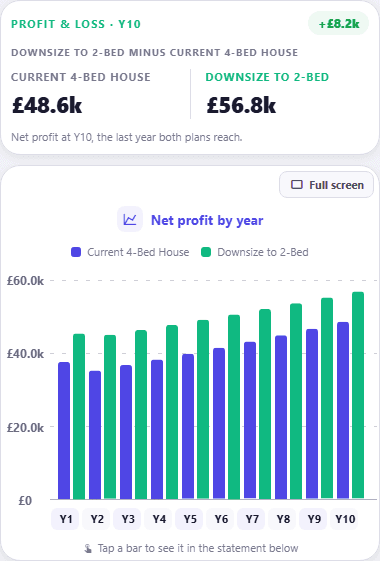
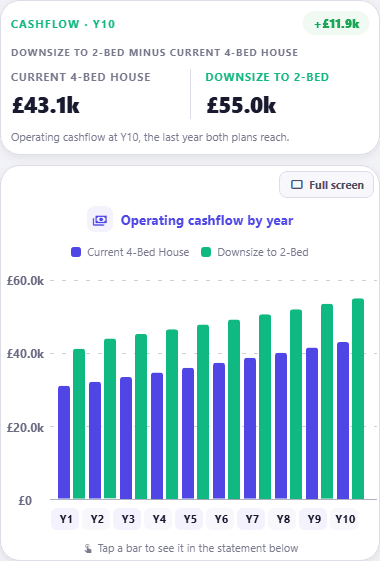
By year ten, though, downsizing comes out ahead on every measure: £40.4k of net profit against £35.4k for staying, operating cashflow £8.2k a year better, and £17.5k more net worth. The margin is real and it is smaller than the brochure version of this decision suggests, because £9,425 of moving costs come off the top and never come back. What drives it is the £95,575 of mortgage that stops accruing interest and the monthly payment that goes with it, and unlike the upsizing example we've modelled elsewhere, the freed-up cashflow compounds faster than the value the household gives up by owning a smaller house. Downsizing deserves a fairer hearing than its reputation suggests, and your own figures are the way to give it one.
›How to check this
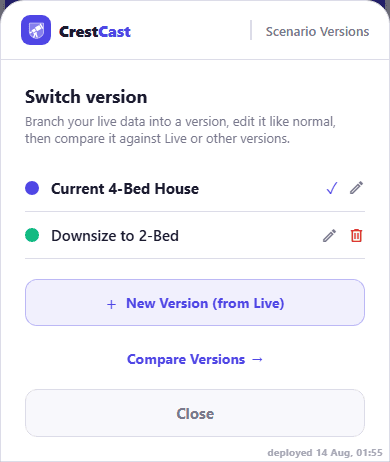
This example uses CrestCast's demo household as a starting point, with the Live data renamed to "Current 4-Bed House" and a branched "Downsize to 2-Bed" version created from it. You can open the same household at crestcast.app/?demo=1 and rebuild the branch yourself.
The new mortgage is derived, not chosen. Equity is £295,000 less the £182,000 mortgage, so £113,000. Moving costs are £4,425 of estate agent fees (1.5% of the sale price, including VAT), £2,500 of solicitor fees across both transactions, £1,200 of removals and £1,300 of Stamp Duty Land Tax on a £190,000 purchase at the England and Northern Ireland mover rates in force since April 2025: £9,425 in total, or 5.0% of the purchase price. That leaves £103,575 towards £190,000, so the branch carries an £86,425 mortgage. No cash moves in or out of the household's accounts on the move, which is what makes the two branches comparable.
Three things changed on the branch: the property value (£295,000 to £190,000), the mortgage (£182,000 to £86,425 balance, 5.2% to 4.8% rate, same 24-year term), and two bills that scale with a smaller home (Council Tax £142 to £108/mo, Gas & Electric £110 to £78/mo). Income, other assets and everything else were left untouched.
Growth rates in CrestCast are real rates, meaning growth above inflation. The demo household's property grows at 3% above inflation, with inflation set at 2.5%. That is a generous assumption for house prices and it runs against the downsize, because it is the larger house that compounds on the bigger number: on a lower property assumption the branch pulls ahead sooner and by more. Change it in Settings and the whole comparison re-runs.
The charts show the Household view (both partners' finances combined) over a 10-year forecast, comparing the two branches via CrestCast's Compare Versions screen, in nominal money rather than today's money. Both branches run with the same inflation and asset-growth assumptions, so the gap between the bars comes from the move itself rather than from how the two were projected.
Run the move before you call the agent
Enter the sale as a dated event in a saved version: the mortgage settles from the proceeds, the smaller house goes on the balance sheet, and you read the difference across all three statements.
30 days free, no card. Then £7.99 a month or £79.99 a year for the whole household.
Put your own numbers in and see the next ten years.
30 days free, no card. Then £7.99 a month or £79.99 a year for the whole household.
These figures are the sample household's. Open its forecast. Open the sample forecast →