Should I Buy a House or Keep Renting? A Parent's Perspective
Whether to buy or rent looks like a financial decision. For parents, it's really about stability and security, and sometimes the numbers alone won't give you the answer.
This article represents a personal view and is not financial or family advice. Every family's circumstances are different, and any major financial decision should be considered carefully in the context of your own situation.
There are questions in life that look like financial decisions but are really something else entirely. Whether to buy a home or continue renting is one of them.
On the surface it looks like a spreadsheet problem. Compare the mortgage payment against the rent. Factor in the deposit, the stamp duty, the solicitor's fees. Project forward ten years and see which number is bigger, and the decision makes itself.
Except it isn't quite that simple, and if you're a parent you probably already know why.
What Most Calculators Miss
When you become responsible for children, your relationship with money changes. The goal is no longer to maximise your own wealth. It shifts towards something harder to quantify: creating the conditions in which your family can flourish.
Stability and security are, I'd argue, the most important things a parent can provide a child, more than the biggest house, the best car, or even the most impressive holiday. Children thrive when they feel safe, rooted and certain of their environment. They struggle when the ground keeps shifting beneath them.
A home you own can provide exactly that kind of anchor. The same bedroom. The same school. The same walk to the corner shop. The same neighbours who know your children's names. These things are invisible on a balance sheet but they matter enormously to a developing child.
This is what pushes so many families toward buying. Not greed. Not investment logic. A deep, reasonable instinct that a permanent home is a better platform for raising children than a tenancy somebody else can end.
That instinct survives the law changing. The Renters' Rights Act 2025 abolishes assured shorthold tenancies and with them the old no-fault Section 21 notice, which is a real improvement and is not the same thing as a permanent home. A landlord can still take the property back to sell it or to move in themselves once the tenancy has run a year. The odds of having to move are lower than they were. The decision is still not yours.
When Buying Undermines the Very Thing It's Supposed to Provide
Here is where it gets complicated.
Buying a home only delivers stability and security if you can genuinely afford it. A mortgage that consumes every spare pound, leaving no room for a boiler breakdown, a redundancy, or a maternity leave that pays less than expected, isn't security. That's a different kind of precariousness, one with much higher stakes than renting.
Financial stress inside a home is corrosive. It changes the atmosphere. Parents argue. Decisions get deferred. The family trip doesn't happen. The school uniform comes late. Children are perceptive, and they pick up on this tension even when they're not supposed to.
So the question isn't simply "should we buy?" It's "can we buy without the buying itself becoming a source of instability?" That is a financial question, and it deserves a rigorous answer before you sign anything.
What the Numbers Can Tell You
This is where CrestCast earns its place. You can model your household finances across both scenarios (continuing to rent versus purchasing at a given price) and see clearly what each path looks like year by year across the ten-year forecast.
The first of those questions has a quick answer worth getting before the longer one: the mortgage affordability calculator will tell you what a purchase at a given price actually costs each month, which is the figure to set against the rent you pay now.
How does the mortgage payment compare to your rent, net of everything else? What happens to your monthly cashflow? Does buying free up money over time as the mortgage stays fixed and your income grows, or does it remain a squeeze? What does your net worth look like either way, counting both the house equity and your broader financial position?
Running this through a proper household forecast removes the fog. It replaces "I think we could afford it" with something more grounded: here is what the numbers actually say, month by month, year by year. If the model shows the mortgage is comfortably manageable alongside your other commitments, that's meaningful. If it shows you'd be stretched to the point of fragility, that's also meaningful, and it's better to know before you commit than after.
Consider a worked example: a household with a £295,000 house and a £182,000 mortgage at 5.2%, against the alternative of never having bought and renting an equivalent home at £1,450 a month instead, with the £60,000 deposit invested rather than tied up in a property.
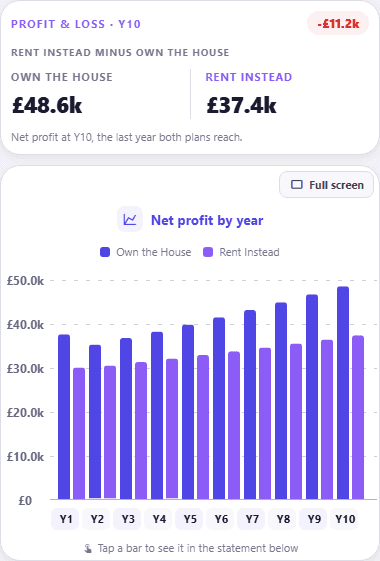
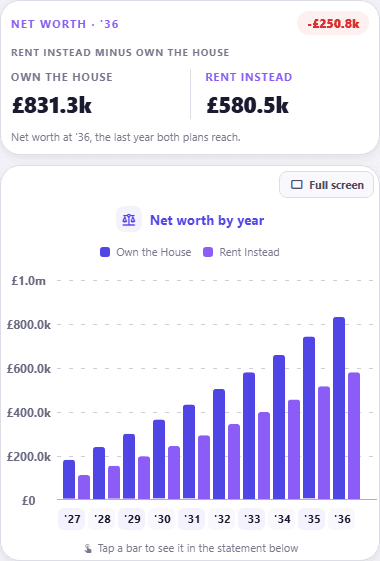
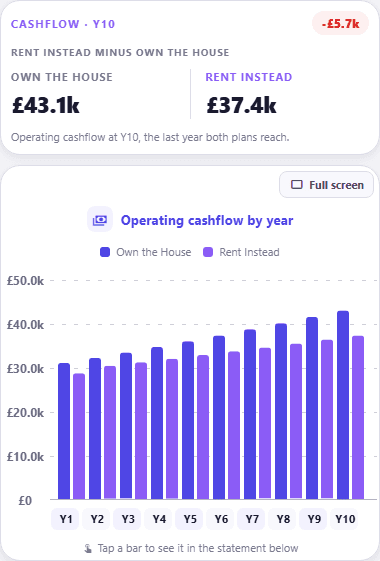
In this example, owning comes out ahead on net worth by year ten, £789.6k against £476.3k in future pounds, a gap of £313.3k: the property's growth plus the falling mortgage balance outpaces what the invested deposit alone achieves, and the rent keeps rising with inflation while the mortgage capital does not. That result rests on the rent and growth assumptions set out in the methodology below. Put your own rent and your own deposit in and you get the same three charts for your household instead of this one.
What the Numbers Cannot Tell You
And yet. There are factors that matter enormously to a family's quality of life that no spreadsheet can capture.
- Is the neighbourhood safer? If moving from renting to buying means moving from an area where you worry about your children playing outside to one where they can roam freely, that has real value, to them and to you.
- What are the schools like? In the UK, catchment areas are everything. Buying in the right postcode can meaningfully shape your child's educational opportunities in ways you can't put a precise number on.
- Is the home itself better suited to family life? A garden. A spare room that becomes a teenager's retreat. Space to have the grandparents stay. These things contribute to daily life in ways that compound quietly over years.
- How close is your support network? Proximity to family, whether grandparents who can help with childcare or siblings your children grow up alongside, can be worth more to a young family than almost any financial metric.
- Environment and green space. Water quality, air quality, access to parks and open land. These can sound like minor considerations until you're the parent of a child with asthma, or your children have nowhere green to spend the summer.
- The intangible feeling of permanence. There is something that happens when a family stops treating a place as temporary. You plant things in the garden. You paint the walls the colour you actually want. You invest in the community around you, emotionally as well as financially.
So What's the Answer?
There isn't a universal one.
For some families, buying now is clearly right: affordable, stable, and into an environment that will genuinely improve their lives. For others, the numbers show that buying would place them under real financial pressure, and the right answer is to wait, to save more, to keep renting somewhere they like for now.
For others still, the finances would work, but the home they could afford to buy is in a location they don't want to commit to long-term. That's also a valid reason to pause.
The mistake is to treat this as a purely financial decision, or, equally, to treat it as a purely emotional one. It's both.
Use CrestCast to model it. Run the scenarios. Be honest with yourselves about what you can comfortably carry. And then weigh the school at the end of the road, the garden where your children will play, and the sense that this is somewhere you can properly put down roots. That's the decision, a significant one, and worth taking your time over.
›How to check this
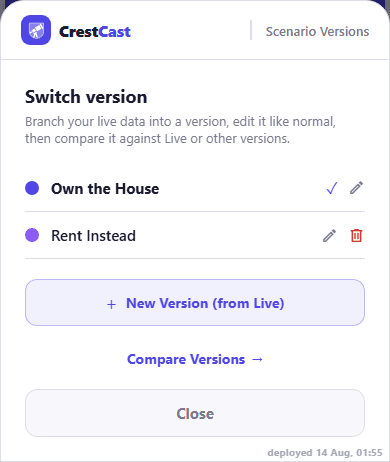
This example uses CrestCast's demo household, with the Live data renamed "Own the House" and a branched "Rent Instead" version created from it.
On the branch: the Family Home asset and Mortgage liability were removed entirely, a Rent bill was added (£1,450/month), and a new investment asset was added representing the deposit invested instead of spent on a property (£60,000, growing at 7% a year). Council Tax, Gas & Electric and Water were left unchanged, since tenants pay these too in the UK. Income and everything else were also left untouched.
Growth rates in CrestCast are real rates, meaning growth above inflation, so that 7% is 7% above inflation and the demo household's property runs at 3% above inflation. Both are punchy. 7% real is well above the 4% or so a diversified equity portfolio has historically delivered after inflation, and it is the renting branch that carries it, so this comparison is a favourable case for renting rather than an unfavourable one. Change either rate in Settings and the whole comparison re-runs on your own assumptions.
The charts show the Household view (both partners' finances combined) over a 10-year forecast, comparing the two branches via CrestCast's Compare Versions screen, in nominal money rather than today's money. Both branches run with the same inflation and asset-growth assumptions, so the rent rises over the decade in the same way the property value and the invested deposit do.
Housing law: the Renters' Rights Act 2025 received Royal Assent on 27/10/2025 and abolishes assured shorthold tenancies, and with them the Section 21 no-fault notice. Grounds 1 and 1A, a landlord moving in or selling, require the tenancy to have run at least a year. Checked against the Act on legislation.gov.uk on 05/09/2026. Commencement of the tenancy reforms is by regulations, so check the current position before relying on it.
Put the buy and the rent side by side
Build each path as a saved version from your real figures and compare them across cashflow, profit and loss and net worth, so the family decision starts from numbers you trust.
30 days free, no card. Then £7.99 a month or £79.99 a year for the whole household.
Put your own numbers in and see the next ten years.
30 days free, no card. Then £7.99 a month or £79.99 a year for the whole household.
These figures are the sample household's. Open its forecast. Open the sample forecast →