How a Loan Works: Interest, Equity, and the Real Cost of Borrowing
Every loan repayment holds interest and capital, and only one builds your wealth. A £250,000 mortgage worked through year by year, with the total cost at different rates and terms.
Most people know roughly what their mortgage costs per month. Far fewer know what that payment is actually made up of, and the difference matters more than you might think.
Every Repayment Has Two Parts
Every loan repayment, whether it's a mortgage, a car finance agreement, or a personal loan, contains two distinct components: interest and capital.
Interest is the cost of borrowing. It goes to the lender rather than building anything for you, a pure expense.
Capital (also called the principal repayment) reduces the outstanding loan balance. It builds equity, the share of the asset that belongs to you rather than the bank. When you make a capital repayment, you are effectively buying back a piece of your own property.
Why the Split Changes Over Time
In the early years of a repayment mortgage, the vast majority of each monthly payment is interest. This is because the outstanding balance is at its highest, so the interest charge is at its largest. As you make repayments and the balance falls, the interest component shrinks, and more of each payment goes to capital.
Take a £250,000 mortgage at 4.5% over 25 years. The monthly repayment is £1,390 and it never changes. In the first month £938 of it is interest and £452 is capital. After ten years the split is £681 and £708, and after twenty it is £280 and £1,110. The payment is the same every month; what it is doing has changed completely.
Month by month the crossover comes in month 116, a little before the ten-year mark: from then on more of each payment buys equity than pays the lender. In the first year £11,137 of the £16,675 paid is interest. In the last year it is £399.
The Total Cost Is Much Higher Than the Loan
Over the full 25-year term of the mortgage above, the total amount repaid would be approximately £417,000, on a £250,000 loan. The additional £167,000 is interest: the cumulative cost of borrowing over two and a half decades.
This is not a reason to avoid mortgages. Borrowing to buy a home you'll live in for decades is often entirely rational. The headline purchase price and the total cost of ownership are simply very different numbers.
Rate and term move the total by more than most people expect. On the same £250,000:
- At 4%, 4.5% and 5% over 25 years the payments are £1,320, £1,390 and £1,461 a month, and the lifetime interest is £145,878, £166,874 and £188,443.
- At 4.5% over 20, 25 and 30 years the payments are £1,582, £1,390 and £1,267 a month, and the lifetime interest is £129,590, £166,874 and £206,017.
Half a point on the rate moves the lifetime interest by about £21,000. Five more years on the term lowers the payment by £123 a month and adds about £39,000 of interest. A lower payment and a cheaper loan are different things.
The same gap opens up on smaller borrowing too, and it is usually worth seeing before you sign rather than after. The loan repayment calculator gives you the monthly payment and the total interest on a personal loan or car finance agreement, so the real cost sits next to the headline amount borrowed.
What This Means for Your P&L and Your Balance Sheet
Only the interest in each payment is a cost to you. The capital moves from your cash into the equity in your home, so it leaves your account without leaving your net worth. How the same payment appears on each of the three statements is worked through in Cash Flow Forecast vs Profit and Loss: the full payment in cashflow, the interest alone in profit and loss, and the capital as a rise in equity on the balance sheet.
Interest-Only Mortgages
Some homeowners hold interest-only mortgages. On an interest-only deal, your monthly payment covers only the interest, with none of it reducing the capital balance. Your cashflow outgoing is lower, but at the end of the term you still owe the full original loan amount. No equity has been built through repayments. The property's value may have risen, but your debt has not reduced.
Interest-only products were common before the 2008 financial crisis and many borrowers found themselves with a large sum due at the end of a term and no plan to repay it. If you have one, it's worth knowing exactly when it ends and what your repayment strategy is.
Overpaying: Why Timing Matters
Understanding the interest/capital split also clarifies why overpaying early in a mortgage has such a disproportionate impact. An extra £200 a month on the £250,000 loan above, from the first month, finishes it 5 years and 1 month early and saves about £38,458 of interest. The same £200 a month started at the beginning of year 20 finishes it 10 months early and saves about £1,813. The maths strongly favours overpaying early, if overpaying is the right move for your overall financial position.
How much difference that actually makes depends entirely on your own balance, rate and remaining term. The mortgage overpayment calculator puts your figures in and shows the years knocked off the term and the interest saved, which is the right way to judge whether the money is better sent at the debt than left elsewhere.
Seeing the Split for Your Own Mortgage
Most mortgage statements just show the payment leaving your account, not how it splits between interest and capital, or how that split will shift over the years you hold the loan. CrestCast models this properly for your household. Run it forward and you can see exactly when the balance of a payment tips from mostly interest to mostly capital, and what an overpayment today is worth in interest saved over the full remaining term. A mortgage is rarely the only thing you owe, and the debt payoff planner is the same treatment applied to all of them at once: the loans, the cards and the student loan alongside it, with the month each one clears.
›How to check this
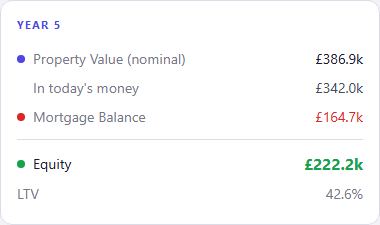
Taken from CrestCast's demo household's Family Home: current value £295,000, mortgage £182,000 at 5.2% over 24 years, on a fixed deal that ends during the forecast and then reverts to a 7.5% standard variable rate. The figures shown are Year 5 of the forecast. The asset's stated 3%/yr growth rate is a real rate, meaning growth above inflation, so the nominal value carries the forecast's inflation assumption on top of it: £295,000 reaches £342.0k in today's money and £386.9k nominal by year five, while the mortgage balance amortises down to £160.1k. The "in today's money" line is the app restating that nominal value in current spending power.
For a live example of a mortgage inside a full household forecast, see "Should I Overpay My Mortgage? A UK Example" or "Should I Upsize My Home?", both of which model a real mortgage's effect on Cashflow, Profit & Loss (P&L) and Net Worth.
The £250,000 figures are standard repayment amortisation at 4.5% a year over 300 monthly payments: payment = P × r(1+r)^n ÷ ((1+r)^n − 1) with r = 4.5% ÷ 12, then each month's interest is the balance times r and the rest of the payment is capital. Amounts are rounded to the nearest pound. The same maths runs the public loan repayment and mortgage overpayment calculators, so every number here can be reproduced there. A lender's own schedule can differ by a few pounds depending on how it applies interest.
See any loan's real cost inside your own plan
CrestCast splits every repayment into interest and capital, shows what the debt costs over its whole life, and tells you the month it clears.
30 days free, no card. Then £7.99 a month or £79.99 a year for the whole household.
Put your own numbers in and see the next ten years.
30 days free, no card. Then £7.99 a month or £79.99 a year for the whole household.